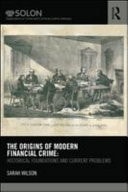
The Origins of Modern Financial Crime in Britain: Historical Foundations and Current Problems
0
0
As an Amazon Associate and affiliate partner, Menrva Books earns from qualifying purchases. Learn more
Author Description
The Recent Global Financial Crisis Has Been Characterised As A Turning Point In The Way We Respond To Financial Crime. Focusing On This Change And 'crime In The Commercial Sphere', This Text Considers The Legal And Economic Dimensions Of Financial Crime And Its Significance In Societal Consciousness In Twenty-first Century Britain. Considering How Strongly Criminal Enforcement Specifically Features In Identifying The Post-crisis Years As A 'turning Point', It Argues That Nineteenth-century Encounters With Financial Crime Were Transformative For Contemporary British Societal Perceptions Of 'crime' And Its Perpetrators, And Have Lasting Resonance For Legal Responses And Societal Reactions Today. The Analysis In This Text Focuses Primarily On How Victorian Society Perceived And Responded To Crime And Its Perpetrators, With Its Reactions To Financial Crime Specifically Couched Within This. It Is Proposed That Examining How Financial Misconduct Became Recognised As Crime During Victorian Times Makes This An Important Contribution To Nineteenth-century History. Beyond This, The Analysis Underlines That A Historical Perspective Is Essential For Comprehending Current Issues Raised By The 'fight' Against Financial Crime, Represented And Analysed In Law And Criminology As Matters Of Enormous Intellectual And Practical Significance, Even Helping To Illuminate The Benefits And Potential Pitfalls Which Can Be Encountered In Current Moves For Extending The Reach Of Criminal Liability For Financial Misconduct. Sarah Wilson's Text On This Highly Topical Issue Will Be Essential Reading For Criminologists, Legal Scholars And Historians Alike. It Will Also Be Of Great Interest To The General Reader.
Menrva's Summary
THE THESIS
This book investigates how nineteenth-century Victorian perceptions of financial misconduct established the foundational framework for modern British legal and societal responses to financial crime. Author Sarah Wilson, a scholar in legal history and criminology, utilizes historical analysis to argue that contemporary reactions to commercial crime are deeply rooted in Victorian-era definitions and moral judgments. By tracing the evolution of these concepts, the text provides a critical lens through which to evaluate current legislative efforts and the expansion of criminal liability in the financial sector.
THE SCOPE MAP
What You Will Find
- Historical analysis of Victorian-era legal definitions regarding business and commercial misconduct.
- Interdisciplinary frameworks combining criminology, legal history, and economic theory.
- Examination of the societal consciousness and public perception of financial perpetrators over two centuries.
- Evaluation of the post-crisis regulatory environment in twenty-first-century Britain compared to historical precedents.
THE AUTHORITY PERSPECTIVE
Experts and scholars in the fields of law and history recognize this work as a significant contribution to understanding the long-term evolution of financial regulation. Readers frequently note the academic density of the prose, which serves as a foundational text for those studying the intersection of historical criminology and modern economic policy.
Page Count:
0
Publication Date:
2014-01-01
Publisher:
Routledge,
ISBN-10:
0203101936
ISBN-13:
9780203101933
Economics
History
British History
Criminology
Law
Victorian Era
Community Tags
Similar Books