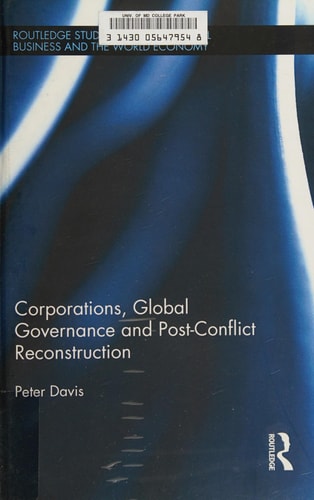
Corporations, Global Governance, and Post-Conflict Reconstruction
0
0
As an Amazon Associate and affiliate partner, Menrva Books earns from qualifying purchases. Learn more
Author Description
Over the past 20 years, the international community has shown an increased desire to intervene to re-build societies emerging from war. From East Timor to Bosnia; from Azerbaijan to Mozambique, UN agencies and bilateral donors have stepped in to create stable durable societies in the aftermath of conflict. During the same period, there has also been increased attention paid to the developing role on the world stage of multinational companies. Statistics suggesting that 51 of the world's largest economies are corporations, and the acceleration of so-called "globalisation" has led to a considerable focus on how private sector organisations fit into established processes of global governance. This book looks at the impact multinational companies have in post-conflict environments, the role they have and how they are governed. Drawing on detailed fieldwork in three post-conflict countries-- Azerbaijan, Bosnia and Rwanda--Peter Davis considers in each case the impacts that international companies have had on the reconstruction programme in each location, and what governance processes are used by companies and by state agencies to manage these impacts. Based on this evidence, this book then draws hypotheses about how the international corporate sector might better be integrated into post-conflict efforts, and considers the implications of this both for how companies manage themselves, and for how the development community's relationship with the private sector
Menrva's Summary
THE THESIS
This book investigates the intersection of multinational corporate influence and international post-conflict reconstruction efforts to determine how private sector entities can be effectively integrated into global governance frameworks. Peter Davis utilizes his academic background to analyze the shifting landscape of international intervention, where corporate entities often possess economic power rivaling that of nation-states. By examining the tension between traditional state-led reconstruction and the expanding role of private enterprise, the author argues for a more structured approach to managing corporate impact in fragile, post-war environments.
THE SCOPE MAP
What You Will Find
- Comparative analysis of reconstruction efforts in Azerbaijan, Bosnia, and Rwanda.
- Evaluation of governance processes used by both state agencies and multinational corporations.
- Empirical evidence derived from extensive field research and case studies.
- Proposed hypotheses for integrating the international corporate sector into development and peacebuilding initiatives.
THE AUTHORITY PERSPECTIVE
Experts recognize this work as a significant contribution to the study of corporate social responsibility within the specific context of international development. Readers frequently note the academic density of the prose, which provides a rigorous framework for understanding the complex relationship between private capital and global governance.
Page Count:
0
Publication Date:
2012-01-01
Publisher:
Routledge
ISBN-10:
0203107640
ISBN-13:
9780203107645
Science
Business
Economics
Business Ethics
International relations
Business Economics
Conflict Resolution
Globalization
Community Tags
Similar Books