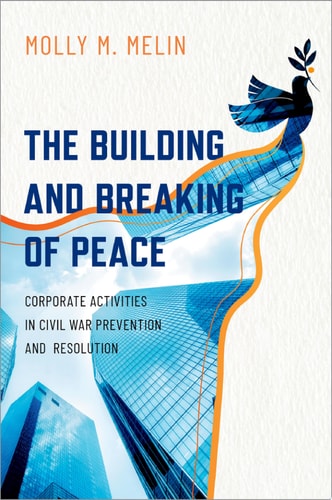
The Building and Breaking of Peace: Corporate Activities in Civil War Prevention and Resolution
0
0
As an Amazon Associate and affiliate partner, Menrva Books earns from qualifying purchases. Learn more
Author Description
Private corporations are rarely discussed as playing a role in efforts to curb civil violence, even though they often have strong interests in maintaining stability. Violence often damages the infrastructure necessary to deliver goods to market or may directly target companies. Corporations also have a normative obligation to conduct business in ways that promote peace. While there are historical examples of firm-instigated violence and firms reaping benefits from instability and conflict, there is also evidence that corporations proactively engage in peacebuilding. For example, firms devise programs to promote economic development, offer access to education, and employ former combatants. In The Building and Breaking of Peace, Molly M. Melin develops a theory of the conflicting roles corporations play in both building and preventing peace. Melin shows that corporations engage in peacebuilding when there is a gap in the state's capacity to enforce laws, but they also weigh the opportunity costs of peacebuilding, responding to the need for action when conditions enable them to do so. Firms are uniquely situated in their ability to raise the cost of violence, and proactive firms can increase the years of peace in a country. At the same time, an active private sector can make it harder for states with ongoing conflict to reach an agreement, as they act as an additional veto player in the bargaining process.Including original cross-national data of peacebuilding efforts by firms in Latin America, the Middle East, and Africa from 2000 to 2018, and in-depth case analyses of corporate actions and outcomes in Colombia, Northern Ireland, and Tunisia, Melin shows that corporations help to prevent violence but not resolve it. In examining the corporate motives for peacebuilding and the implications of these activities for preventing violence and conflict resolution, the book builds a more holistic picture of the peace and conflict process. The findings also help explain why arm
Menrva's Summary
THE THESIS
This book investigates the dual role of private corporations as both potential agents of peacebuilding and obstacles to conflict resolution in regions experiencing civil violence. Molly M. Melin, an expert in international relations and conflict, utilizes a theoretical framework that balances corporate self-interest with the state's capacity to maintain order. By analyzing the opportunity costs of peacebuilding, the author argues that while firms can effectively raise the cost of violence, their presence as additional veto players can complicate formal peace negotiations.
THE SCOPE MAP
What You Will Find
- Cross-national data sets covering corporate peacebuilding efforts in Latin America, the Middle East, and Africa from 2000 to 2018.
- Comparative case studies focusing on corporate actions and outcomes in Colombia, Northern Ireland, and Tunisia.
- A theoretical model explaining the conditions under which firms choose to intervene in state-level stability.
- Analysis of the tension between corporate economic incentives and the normative obligations of business in conflict zones.
THE AUTHORITY PERSPECTIVE
Scholars in the field of international political economy recognize this work as a significant contribution to the study of non-state actors in conflict zones. Readers frequently note the rigorous use of both quantitative data and qualitative case studies to support the author's nuanced conclusions regarding corporate influence.
Page Count:
257
Publication Date:
2021-01-01
Publisher:
Oxford University Press
ISBN-10:
0197579388
ISBN-13:
9780197579381
Economics
Conflict Resolution
International relations
Business Ethics
Peace studies
Community Tags
Similar Books