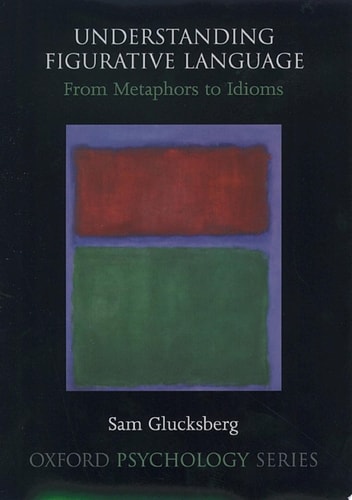
Understanding Figurative Language: From Metaphor to Idioms
0
0
As an Amazon Associate and affiliate partner, Menrva Books earns from qualifying purchases. Learn more
Author Description
This book examines how people understand utterances that are intended figuratively. Traditionally, figurative language such as metaphors and idioms has been considered derivative from more complex than ostensibly straightforward literal language. Glucksberg argues that figurative language involves the same kinds of linguistic and pragmatic operations that are used for ordinary, literal language. Glucksberg's research in this book is concerned with ordinary language: expressions that are used in daily life, including conversations about everyday matters, newspaper and magazine articles, and the media. Metaphor is the major focus of the book. Idioms, however, are also treated comprehensively, as is the theory of conceptual metaphor in the context of how people understand both conventional and novel figurative expressions. A new theory of metaphor comprehension is put forward, and evaluated with respect to competing theories in linguistics and in psychology. The central tenet of the theory is that ordinary conversational metaphors are used to create new concepts and categories. This process is spontaneous and automatic. Metaphor is special only in the sense that these categories get their names from the best examples of the things they represent, and that these categories get their names from the best examples of those categories. Thus, the literal "shark" can be a metaphor for any vicious and predatory being, from unscrupulous salespeople to a murderous character in The Threepenny Opera. Because the same term, e.g.,"shark," is used both for its literal referent and for the metaphorical category, as in "My lawyer is a shark," we call it the dual-reference theory. The theory is then extended to two other domains: idioms and conceptual metaphors. The book presents the first comprehensive account of how people use and understand metaphors in everyday life.
Menrva's Summary
THE THESIS
This book investigates the cognitive mechanisms underlying how individuals comprehend figurative language, challenging the traditional view that such expressions are more complex than literal speech. Sam Glucksberg, a prominent researcher in cognitive psychology, utilizes experimental data and linguistic analysis to argue that figurative language processing relies on the same pragmatic operations as literal communication. He introduces the dual-reference theory, proposing that metaphors function by creating spontaneous, automatic categories that allow speakers to convey complex concepts through familiar terms.
THE SCOPE MAP
What You Will Find
- A comprehensive analysis of metaphor comprehension in everyday conversation and media.
- The dual-reference theory of metaphor, which explains how terms like 'shark' function as both literal objects and metaphorical categories.
- Examination of idioms and conceptual metaphors within a unified cognitive framework.
- Comparative evaluations of the author's theory against competing models in linguistics and psychology.
Scope Limits
- The text focuses primarily on cognitive and psychological processes rather than literary or poetic analysis of figurative language.
- It does not cover historical etymology or the evolution of language over long periods.
THE AUTHORITY PERSPECTIVE
Experts recognize this work as a foundational text for understanding the cognitive psychology of language. Readers frequently note the academic density of the prose, which is tailored for students and researchers in linguistics and cognitive science.
Page Count:
136
Publication Date:
2001-01-01
Publisher:
Oxford University Press
ISBN-10:
0190283181
ISBN-13:
9780190283186
Psychology
Linguistics
English & College Success
Language
Communication
English
Community Tags
Other Editions(2)
Similar Books


Reader Comments
Share Your Thoughts
No comments yet. Be the first to share your thoughts!