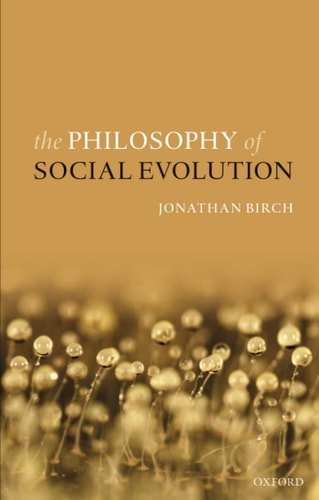
The Philosophy of Social Evolution
0
0
As an Amazon Associate and affiliate partner, Menrva Books earns from qualifying purchases. Learn more
Author Description
From mitochondria to meerkats, the natural world is full of spectacular examples of social behaviour. In the early 1960s Bill Hamilton changed the way we think about how such behaviour evolves. He introduced three key innovations - now known as Hamilton's rule, kin selection, and inclusive fitness - which have been enormously influential, but which remain the subject of fierce controversy. Hamilton's pioneering work kick-started a research program now known as social evolution theory. This is a book about the philosophical foundations and future prospects of that program. Part I, "Foundations", is a careful exposition and defence of Hamilton's ideas, with a few modifications along the way. In Part II, "Extensions", Jonathan Birch shows how these ideas can be applied to phenomena including cooperation in micro-organisms, cooperation among the cells of a multicellular organism, and culturally evolved cooperation in the earliest human societies. Birch argues that real progress can be made in understanding microbial evolution, evolutionary transitions, and human evolution by viewing them through the lens of social evolution theory, provided the theory is interpreted with care and adapted where necessary. The Philosophy of Social Evolution places social evolution theory on a firm philosophical footing and sets out exciting new directions for further work.
Menrva's Summary
THE THESIS
This book investigates the philosophical foundations and future potential of social evolution theory, specifically addressing the controversies surrounding Hamilton's rule, kin selection, and inclusive fitness. Jonathan Birch, a philosopher of biology, provides a rigorous examination of these core concepts. He evaluates the theoretical framework established in the 1960s and proposes necessary adaptations to ensure its continued relevance in modern biological research.
THE SCOPE MAP
What You Will Find
- A detailed exposition and defense of Hamilton's rule and inclusive fitness theory.
- Applications of social evolution theory to microbial cooperation and multicellularity.
- Analysis of cultural evolution in early human societies.
- Philosophical arguments for the integration of social evolution theory across biological disciplines.
Scope Limits
- The text does not provide a general introduction to evolutionary biology for laypeople.
- It does not cover non-social aspects of evolutionary theory.
THE AUTHORITY PERSPECTIVE
Experts recognize this work as a significant contribution to the philosophy of biology, particularly for its precise treatment of complex theoretical debates. Readers frequently note the academic density of the prose, which is best suited for those already familiar with the technical aspects of evolutionary theory.
Page Count:
280
Publication Date:
2017-01-01
Publisher:
OUP Oxford
ISBN-10:
0191047368
ISBN-13:
9780191047367
Philosophy
Science
Biology
Evolutionary Biology