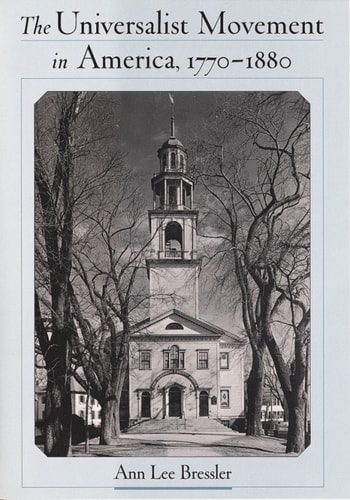
The Universalist Movement in America, 1770-1880
0
0
As an Amazon Associate and affiliate partner, Menrva Books earns from qualifying purchases. Learn more
Author Description
In this volume Ann Lee Bressler offers the first cultural history of American Universalism and its central teaching -- the idea that an all-good and all-powerful God saves all souls. Although Universalists have commonly been lumped together with Unitarians as "liberal religionists," in its origins their movement was, in fact, quite different from that of the better-known religious liberals. Unlike Unitarians such as the renowned William Ellery Channing, who stressed the obligation of the individual under divine moral sanctions, most early American Universalists looked to the omnipotent will of God to redeem all of creation. While Channing was socially and intellectually descended from the opponents of Jonathan Edwards, Hosea Ballou, the foremost theologian of the Universalist movement, appropriated Edwards's legacy by emphasizing the power of God's love in the face of human sinfulness and apparent intransigence. Espousing what they saw as a fervent but reasonable piety, many early Universalists saw their movement as a form of improved Calvinism. The story of Universalism from the mid-nineteenth century on, however, was largely one of unsuccessful efforts to maintain this early synthesis of Calvinist and Enlightenment ideals. Eventually, Bressler argues, Universalists were swept up in the tide of American religious individualism and moralism; in the late nineteenth century they increasingly extolled moral responsibility and the cultivation of the self. By the time of the first Universalist centennial celebration in 1870, the ideals of the early movement were all but moribund. Bressler's study illuminates such issues as the relationship between faith and reason in a young, fast-growing, and deeply uncertain country, and the fate of the Calvinist heritage in American religious history.
Menrva's Summary
THE THESIS
This work investigates the cultural evolution of American Universalism and the eventual decline of its early theological synthesis between 1770 and 1880. Ann Lee Bressler, a scholar of American religious history, examines how the movement transitioned from a form of improved Calvinism centered on divine omnipotence to an individualistic, moralistic faith. By analyzing the writings of figures like Hosea Ballou, Bressler argues that the movement's original theological framework was gradually eroded by the broader cultural shift toward self-cultivation and moral responsibility in the nineteenth century.
THE SCOPE MAP
What You Will Find
- Historical analysis of the Universalist movement from 1770 to 1880
- Comparative study of Universalist theology versus Unitarianism
- Examination of the influence of Calvinist and Enlightenment ideals
- Analysis of the shift toward American religious individualism
Scope Limits
- The study does not focus on the post-1880 development of the Universalist Church
- The text does not provide a comprehensive biography of every Universalist leader
THE AUTHORITY PERSPECTIVE
Experts recognize this volume as a foundational cultural history that distinguishes Universalism from the broader Unitarian tradition. Readers frequently note the academic density of the prose and the author's precise handling of complex theological shifts within the American religious landscape.
Page Count:
213
Publication Date:
2001-01-01
Publisher:
Oxford University Press
ISBN-10:
0190284668
ISBN-13:
9780190284664
History
Religion
Christianity
American History
Cultural History
Universalism
United States
Theology