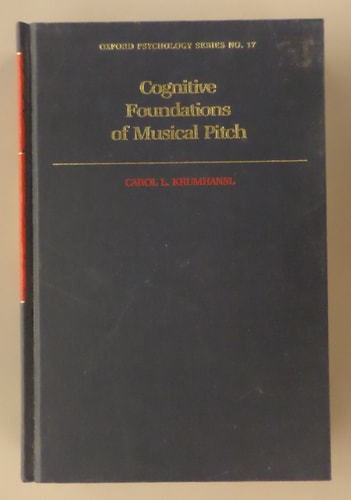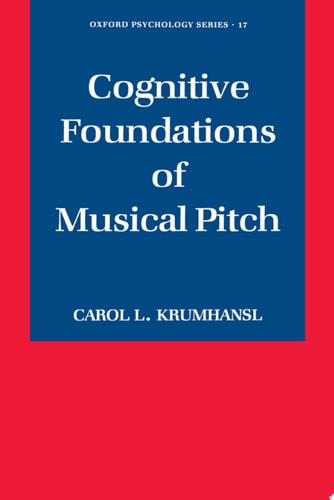
Cognitive Foundations of Musical Pitch
0
0
As an Amazon Associate and affiliate partner, Menrva Books earns from qualifying purchases. Learn more
Author Description
This book addresses the central problem of music cognition: how listeners' responses move beyond mere registration of auditory events to include the organization, interpretation, and remembrance of these events in terms of their function in a musical context of pitch and rhythm. Equally important, the work offers an analysis of the relationship between the psychological organization of music and its internal structure. Combining over a decade of original research on music cognition with an overview of the available literature, the work will be of interest to cognitive and physiological psychologists, psychobiologists, musicians, music researchers, and music educators. The author provides the necessary background in experimental methodology and music theory so that no specialized knowledge is required for following her major arguments.
Menrva's Summary
THE THESIS
This book investigates how human listeners organize, interpret, and remember auditory events to derive meaning from musical pitch and rhythm. Carol L. Krumhansl, a prominent researcher in music cognition, synthesizes over a decade of experimental data to bridge the gap between psychological perception and the formal internal structure of music. The text argues that musical experience is not merely passive registration but an active cognitive process that maps sound onto functional structures.
THE SCOPE MAP
What You Will Find
- Experimental methodologies for measuring pitch perception and tonal hierarchies
- Analysis of the relationship between psychological organization and musical structure
- Theoretical frameworks for understanding rhythm and pitch in context
Scope Limits
- The text does not provide an exhaustive history of music theory
- It does not focus on the clinical treatment of auditory disorders
THE AUTHORITY PERSPECTIVE
Experts recognize this work as a foundational text for those studying the intersection of psychology and musicology. Readers frequently note the academic density of the prose, which remains accessible due to the author's inclusion of necessary background information in experimental design.
Page Count:
315
Publication Date:
2001-01-01
Publisher:
Oxford University Press
ISBN-10:
0190287446
ISBN-13:
9780190287443
Psychology
Psychobiology
Humanities
Music theory
Music Cognition