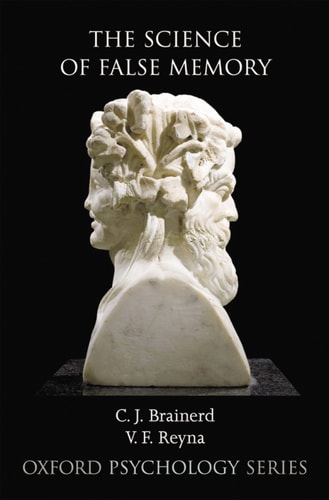
The Science of False Memory
0
0
As an Amazon Associate and affiliate partner, Menrva Books earns from qualifying purchases. Learn more
Author Description
Findings from research on false memory have major implications for a number of fields central to human welfare, such as medicine and law. Although many important conclusions have been reached after a decade or so of intensive research, the majority of them are not well known outside the immediate field. To make this research accessible to a much wider audience, The Science of False Memory has been written to require little or no background knowledge of the theory and techniques used in memory research. Brainerd and Reyna introduce the volume by considering the progenitors to the modern science of false memory, and noting the remarkable degree to which core themes of contemporary research were anticipated by historical figure such as Binet, Piaget, and Bartlett. They continue with an account of the varied methods that have been used to study false memory both inside and outside of the laboratory. The first part of the volume focuses on the basic science of false memory, revolving around three topics: old and new theoretical ideas that have been used to explain false memory and make predictions about it; research findings and predictions about false memory in normal adults; and research findings and predictions about age-related changes in false memory between early childhood and adulthood. Throughout Part I, Brainerd and Reyna emphasize how current opponent-processes conceptions of false memory act as a unifying influence by integrating predictions and data across disparate forms of false memory. The second part focuses on the applied science of false memory, revolving around four topics: the falsifiability of witnesses and suspects memories of crimes, including false confessions by suspects; the falsifiability of eyewitness identifications of suspects; false-memory reports in investigative interviews of child victims and witnesses, particularly in connection with sexual-abuse crimes; false memory in psychotherapy, including recovered memories of childhood abuse.
Menrva's Summary
THE THESIS
This volume investigates the mechanisms, theoretical frameworks, and real-world implications of false memory in human cognition. Authors C. J. Brainerd and V. F. Reyna, both established researchers in cognitive psychology, synthesize a decade of intensive laboratory and field data. They argue that opponent-processes theories provide a unifying structure for understanding how and why memory errors occur across different stages of human development and applied contexts.
THE SCOPE MAP
What You Will Find
- Historical foundations of memory research including the contributions of Binet, Piaget, and Bartlett
- Theoretical models explaining the cognitive processes behind memory distortion
- Empirical data on age-related changes in memory from childhood to adulthood
- Analysis of false confessions and eyewitness identification reliability
- Examination of false memory reports in investigative interviews and psychotherapy
Scope Limits
- The text focuses primarily on cognitive and psychological frameworks rather than neurobiological mapping of specific brain regions
- It does not provide a comprehensive legal manual but rather an overview of psychological principles relevant to legal settings
THE AUTHORITY PERSPECTIVE
Experts recognize this work as a foundational synthesis that bridges the gap between basic cognitive research and applied forensic practice. Readers frequently note the clarity of the prose, which successfully translates complex theoretical models for a broader audience without sacrificing academic rigor.
Page Count:
573
Publication Date:
2005-01-01
Publisher:
Oxford University Press
ISBN-10:
0190288485
ISBN-13:
9780190288488
Psychology
Memory
Forensic Psychology
Neuroscience
Community Tags
Similar Books