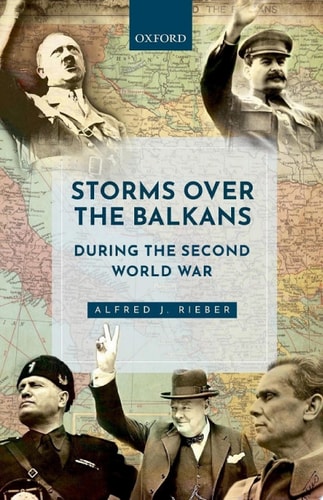
Storms over the Balkans during the Second World War
0
0
As an Amazon Associate and affiliate partner, Menrva Books earns from qualifying purchases. Learn more
Author Description
In a new interpretation of the history of the Balkans during the Second World War, Alfred J. Rieber explores the tangled political rivalries, cultural clashes, and armed conflicts among the great powers and the indigenous people competing for influence and domination. The study takes an original approach to the region based on the geography, social conditions, and imperial rivalries that spans several centuries, culminating in three wars during the first half of the twentieth century. Against this background, Rieber focuses on leadership - personified by Mussolini, Hitler, Stalin, Churchill, and Tito - as the key to explaining events. For each one the Balkans represented a strategic prize vital for the fulfilment of their ambitious war aims. For the local forces the destabilization of the war offered the opportunity to reorder societies, expel ethnic minorities, and expand national borders. Storms over the Balkans during the Second World War illustrates how the leaders of the external powers were forced to improvise their tactics and compromise their ideologies under the pressure of war and the competing claims of their allies and clients. Neither the Axis nor the Allied camps were uniform blocs, and deep divisions ran through the ranks of the resistance and those collaborating with the occupying powers. These tensions contributed to the failure of all the participants in the struggle to achieve their aims. The complexities of the wartime experiences help to explain the persistence of memories and unfulfilled aspirations that continue to haunt the region. The study is based on extensive research in new sources in seven languages.
Menrva's Summary
THE THESIS
This study investigates how the intersection of imperial rivalries, local ethnic conflicts, and the strategic ambitions of global leaders shaped the chaotic political and military landscape of the Balkans during the Second World War. Alfred J. Rieber, a historian specializing in the history of the Russian Empire and the Soviet Union, utilizes a multi-layered analytical framework to examine the region. By synthesizing archival research in seven languages, he argues that the failure of both Axis and Allied powers to achieve their objectives was driven by the inherent instability of the region and the improvisational nature of wartime leadership.
THE SCOPE MAP
What You Will Find
- Analysis of the strategic motivations of Mussolini, Hitler, Stalin, Churchill, and Tito.
- Examination of the interplay between long-term imperial geography and short-term wartime tactical shifts.
- Investigation into the internal divisions within both resistance movements and collaborationist factions.
Scope Limits
- The text does not provide a comprehensive military history of every individual battle or tactical engagement.
- It focuses primarily on the high-level political and strategic decision-making rather than the granular day-to-day experiences of the civilian population.
THE AUTHORITY PERSPECTIVE
Scholars and historians recognize this work as a significant contribution to the study of Balkan geopolitics due to its extensive use of multi-lingual primary sources. Readers frequently note the academic density of the prose and the author's ability to synthesize complex, multi-century historical trends into a coherent narrative of wartime failure.
Page Count:
200
Publication Date:
2022-01-01
Publisher:
OUP Oxford
ISBN-10:
0192672797
ISBN-13:
9780192672797
History
Balkan Studies
European History
World War
Military History
Community Tags
Similar Books