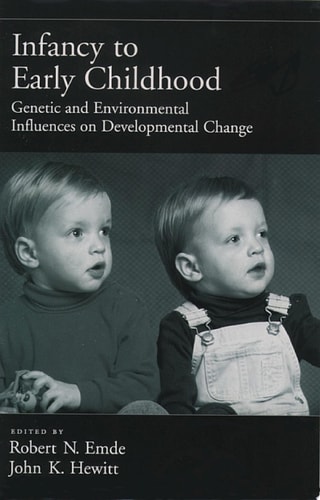
Infancy to Early Childhood: Genetic and Environmental Influences on Developmental Change
0
0
As an Amazon Associate and affiliate partner, Menrva Books earns from qualifying purchases. Learn more
Author Description
Behavioral genetics is a fast-growing, multidisciplinary field which attempts to explain the influence of genetic and environmental factors on behavior through the lifespan. The preferred investigative technique for teasing out the differences between genetics and the environment is the longitudinal twin study. This book is the first complete publication from the MacArthur Longitudinal Twin Study (MALTS) that is by far the most ambitious and comprehensive longitudinal twin study to date. The goal of such an in-depth study was not to merely provide thorough descriptions of developmental change between the ages of one and three years, but to offer an original theoretical framework that explains how change occurs in different domains and how genetics and the environment influence those changes. This rigorous study will set the agenda for developmental psychology and behavioral genetics for decades to come.
Menrva's Summary
THE THESIS
This work investigates how the interplay between genetic predispositions and environmental factors drives developmental change in children between the ages of one and three. The authors, John K. Hewitt and Robert N. Emde, utilize the extensive data collected from the MacArthur Longitudinal Twin Study (MALTS) to move beyond descriptive observation. They propose a theoretical framework designed to explain the mechanisms of change across various developmental domains during early childhood.
THE SCOPE MAP
What You Will Find
- Longitudinal data from the MacArthur Longitudinal Twin Study (MALTS)
- Comparative analysis of genetic versus environmental influences on behavior
- Theoretical models for developmental change in toddlers
- Methodological insights into twin study design
Scope Limits
- Focus is restricted to the age range of one to three years
- Does not cover adolescent or adult developmental stages
THE AUTHORITY PERSPECTIVE
Experts recognize this text as a foundational resource for understanding the application of longitudinal twin studies in developmental psychology. Readers frequently note the academic density of the prose, which is tailored for researchers and students within the behavioral sciences.
Page Count:
407
Publication Date:
2001-01-01
Publisher:
Oxford University Press
ISBN-10:
0190284714
ISBN-13:
9780190284718
Psychology
Science
Family & Consumer Sciences
Twins
Medical
Toddlers
Allied Health
Behavioral Genetics
Academic
Developmental Psychology
Research Methods
Community Tags
Similar Books