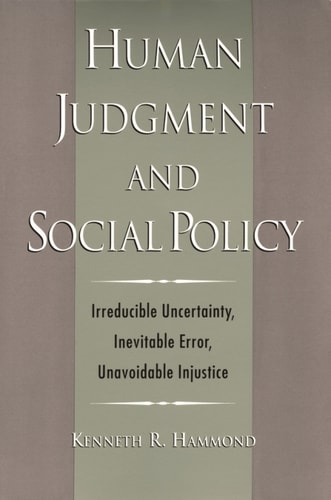
Human Judgment and Social Policy: Irreducible Uncertainty, Inevitable Error, Unavoidable Injustice
0
0
As an Amazon Associate and affiliate partner, Menrva Books earns from qualifying purchases. Learn more
Author Description
From the O.J. Simpson verdict to peace-making in the Balkans, the critical role of human judgement--complete with its failures, flaws, and successes--has never been more hotly debated and analyzed than it is today. This landmark work examines the dynamics of judgement and its impact on events that take place in human society, which require the direction and control of social policy. Research on social policy typically focuses on content. This book concentrates instead on the decision-making process itself. Drawing on 50 years of empirical research in decision theory, Hammond examines the possibilities for wisdom and cognitive competence in the formation of social policies, and applies these lessons to specific examples, such as the space shuttle Challenger disaster and the health care debate. Uncertainly, he tells us, can seldom be fully eliminated; thus error is inevitable, and injustice for some unavoidable. But the capacity for make wise judgments increases to the extent that we understand the potential pitfalls and their origin. The judgment process for example involves an ongoing rivalry between intuition and analysis, accuracy and rationality. The source of this tension requires an examination of the evolutionary roots of human judgement and how these fundamental features may be changing as our civilization increasingly becomes an information and knowledge-based society. With numerous examples from law, medicine, engineering, and economics, the author dramatizes the importance of judgment and its role in the formation of social policies which affect us all, and issues the first comprehensive examination of its underlying dynamics.
Menrva's Summary
THE THESIS
This work investigates the fundamental question of how human judgment functions within the formation of social policy, specifically addressing why error and injustice remain persistent features of decision-making. Kenneth R. Hammond, a prominent researcher in decision theory, synthesizes fifty years of empirical data to argue that uncertainty is an irreducible component of complex social systems. He posits that by understanding the cognitive tension between intuition and analysis, policymakers can improve the quality of their decisions despite the inevitability of flawed outcomes.
THE SCOPE MAP
What You Will Find
- Analysis of the rivalry between intuitive and analytical cognitive processes
- Examination of evolutionary influences on modern judgment
- Case studies including the Challenger disaster, healthcare policy, and legal verdicts
- Theoretical framework for cognitive competence in information-based societies
Scope Limits
- Does not provide a prescriptive manual for eliminating all policy errors
- Does not focus on the specific content of social policies, but rather the underlying decision-making mechanics
THE AUTHORITY PERSPECTIVE
Experts recognize this text as a foundational examination of judgment theory, frequently citing its rigorous application of empirical research to real-world policy failures. Readers often note the academic density of the prose, which requires a strong background in cognitive psychology or decision science to fully grasp the author's arguments.
Page Count:
446
Publication Date:
1996-01-01
Publisher:
Oxford University Press
ISBN-10:
0190282665
ISBN-13:
9780190282660
Psychology
Social Science
Judgment
Decision Making
Professional Career & Trade
Special Topics
Decision Theory
Public Policy
Uncertainty
Community Tags
Similar Books