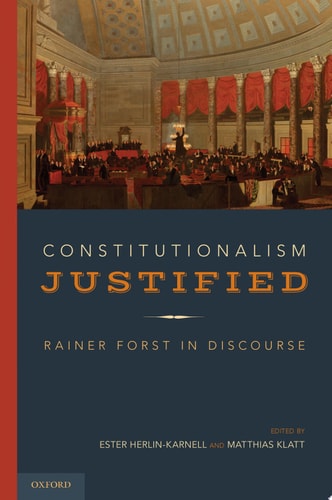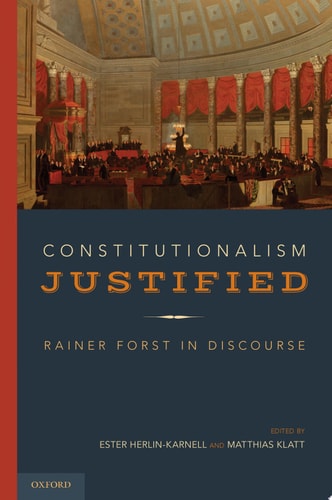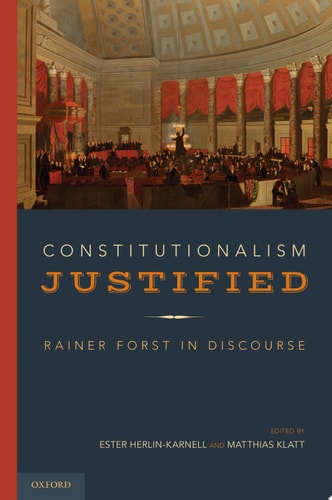
Constitutionalism Justified: Rainer Forst in Discourse
0
0
As an Amazon Associate and affiliate partner, Menrva Books earns from qualifying purchases. Learn more
Author Description
Constitutionalism Justified analyzes leading Frankfurt School theorist Rainer Forst's theory of a basic right to justification, unique in combining insights from philosophy, constitutionalism, and legal theory. Drawing upon Kant's critical philosophy and Habermas's discourse theory, he has developed fresh perspectives on core topics like the concept of justice, the relation between modernity and emancipation, and human rights. The contributors to this volume explore Forst's work from three different perspectives: philosophy, legal philosophy, and constitutional theory.The first part of this volume addresses the philosophical argument of the basic right to justification, including the influence of Kantian thought on this right, the deontological versus teleological fundamentals, the tension between moral pluralism and universalism, and the relation of the right to justification with social and distributive justice. The second part covers how the right to justification is embedded in constitutional and legal frameworks. It explores the implications that Forst's right to justification has for conceptualizing constitutional democracy and its foundations, and how the moral right to justification may translate into particular practices of justification that are constrained by a legal framework. This includes discussion of the value of constitutionalism in general, of the relation between the formal structure of democracy and substantive justice, of the inclusion of outsiders to the constitutional setting, and of proportionality analysis and judicial review as forms of justification. The book concludes with Rainer Forst's reply to his interlocutors, making the book a valuable source for future research.
Menrva's Summary
THE THESIS
This volume investigates the theoretical validity and practical application of Rainer Forst’s concept of a basic right to justification within the spheres of philosophy, constitutionalism, and legal theory. Editors Ester Herlin-Karnell and Matthias Klatt assemble a collection of essays that evaluate how Forst’s synthesis of Kantian critical philosophy and Habermasian discourse theory addresses modern challenges regarding justice, human rights, and the structural foundations of democracy. The contributors analyze the translation of moral imperatives into legal frameworks, providing a comprehensive critique of Forst’s intellectual contributions.
THE SCOPE MAP
What You Will Find
- Philosophical analysis of the basic right to justification and its Kantian roots
- Examination of the tension between moral pluralism and universalism
- Discussions on the intersection of constitutional democracy and substantive justice
- Evaluation of proportionality analysis and judicial review as mechanisms of justification
- A concluding response from Rainer Forst addressing his interlocutors
Scope Limits
- The text focuses primarily on Forst’s specific theoretical framework rather than a broad survey of all contemporary constitutional theories
- It does not provide a general introduction to legal theory for non-specialists
THE AUTHORITY PERSPECTIVE
Scholars and legal theorists identify this volume as a significant contribution to the study of critical theory and constitutional law. Readers frequently note the academic density of the prose, which is intended for an audience already familiar with the works of Forst, Kant, and Habermas.
Page Count:
384
Publication Date:
2019-01-01
Publisher:
Oxford University Press
ISBN-10:
0190889071
ISBN-13:
9780190889074
Philosophy
Legal Theory
Professional Career & Trade
Constitutional Law
Community Tags
Similar Books