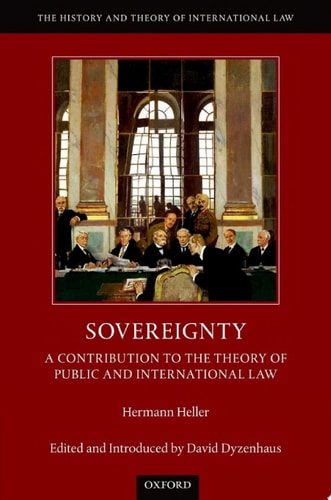
Sovereignty: A Contribution to the Theory of Public and International Law
0
0
As an Amazon Associate and affiliate partner, Menrva Books earns from qualifying purchases. Learn more
Author Description
Hermann Heller was one of the leading public lawyers and legal and political theorists of the Weimar era, whose main interlocutors were two of the giants of twentieth century legal and political thought, Hans Kelsen and Carl Schmitt. In this 1927 work, Hermann Heller addresses the paradox of sovereignty. That is, how the sovereign can be both the highest authority and subject to law. Unlike Kelsen and Schmitt, who seek to dissolve the paradox, Heller sees that the tensions the paradox highlights are an essential part of a society ruled by law. Sovereignty, in the sense of national and popular sovereignty, is often perceived today as being under threat, as power devolves from nation states to international bodies, and important decisions seem increasingly made by elite-dominated institutions. Hermann Heller wrote Sovereignty in 1927 amidst the very similar tensions of the Weimar Republic. In an exploration of history, constitutional and political theory, and international law, Heller speaks clearly to our contemporary concerns, and shows that democrats must defend a legal idea of sovereignty suitable for a pluralistic world.
Menrva's Summary
THE THESIS
How can a sovereign entity maintain supreme authority while simultaneously remaining subject to the constraints of the law? Hermann Heller, a prominent legal and political theorist of the Weimar Republic, investigates this paradox by examining the intersection of national sovereignty, constitutional structure, and international legal frameworks. He argues against the reductionist approaches of his contemporaries, Kelsen and Schmitt, proposing instead that the inherent tensions of sovereignty are fundamental to the maintenance of a rule-based, pluralistic society.
THE SCOPE MAP
What You Will Find
- Analysis of the Weimar-era political and legal climate
- Theoretical framework for reconciling national and popular sovereignty
- Historical examination of the evolution of state authority
- Critique of contemporary legal theories regarding international bodies
Scope Limits
- Does not provide a modern policy manual for current international institutions
- Does not offer a comprehensive history of international law beyond the scope of sovereignty theory
THE AUTHORITY PERSPECTIVE
Scholars recognize this work as a critical intervention in twentieth-century legal thought, particularly for its nuanced critique of Kelsen and Schmitt. Readers frequently note the academic density of the prose, which requires a foundational understanding of Weimar-era political philosophy to fully grasp the author's arguments.
Page Count:
207
Publication Date:
2019-01-01
Publisher:
OUP Oxford
ISBN-10:
0192538519
ISBN-13:
9780192538512
History
Political Philosophy
International Law
Sovereignty
Legal Theory
Constitutional Law
Professional Career & Trade
Community Tags
Similar Books