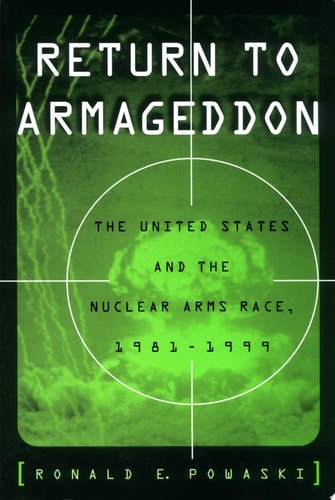
Return to Armageddon: The United States and the Nuclear Arms Race, 1981-1999
0
0
As an Amazon Associate and affiliate partner, Menrva Books earns from qualifying purchases. Learn more
Author Description
When the Cold War ended, the world let out a collective sigh of relief as the fear of nuclear confrontation between superpowers appeared to vanish overnight. As we approach the new millennium, however, the proliferation of nuclear weapons to ever more belligerent countries and factions raises alarming new concerns about the threat of nuclear war.In Return to Armageddon, Ronald Powaski assesses the dangers that beset us as we enter an increasingly unstable political world. With the START I and II treaties, completed by George Bush in 1991 and 1993 respectively, and the Comprehensive Test Ban Treaty (CTBT), signed by Bill Clinton in 1996, it seemed as if the nuclear clock had been successfully turned back to a safer hour. But Powaski shows that there is much less reason for optimism than we may like to think. Continued U.S.-Russian cooperation can no longer be assured. To make matters worse, Russia has not ratified the START II Treaty and the U.S. Senate has failed to approve the CTBT. Perhaps even more ominously, the effort to prevent the acquisition of nuclear weapons by nonweapon states is threatened by nuclear tests conducted by India and Pakistan. The nuclear club is growing and its most recent members are increasingly hostile. Indeed, it is becoming ever more difficult to keep track of the expertise and material needed to build nuclear weapons, which almost certainly will find their way into terrorist hands. Accessible, authoritative, and provocative, Return to Armageddon provides both a comprehensive account of the arms control process and a startling reappraisal of the nuclear threat that refuses to go away.
Menrva's Summary
THE THESIS
This book investigates the persistent and evolving threat of nuclear proliferation in the post-Cold War era, questioning whether international arms control efforts are sufficient to prevent global catastrophe. Ronald E. Powaski, a historian specializing in American foreign policy and nuclear history, utilizes a framework of diplomatic analysis to examine the efficacy of treaties like START I and II. He argues that despite the dissolution of the Soviet Union, the geopolitical landscape remains dangerously volatile due to the expansion of the nuclear club and the failure of major powers to ratify critical disarmament agreements.
THE SCOPE MAP
What You Will Find
- Analysis of U.S.-Russian nuclear diplomacy between 1981 and 1999
- Evaluation of the START I and II treaties and the Comprehensive Test Ban Treaty
- Examination of nuclear proliferation in India and Pakistan
- Assessment of the risks posed by non-state actors and terrorist groups
Scope Limits
- Does not cover nuclear developments post-1999
- Focuses primarily on U.S. policy perspectives rather than internal technical developments within non-Western nuclear programs
THE AUTHORITY PERSPECTIVE
Experts recognize this work as a detailed historical account of late-twentieth-century arms control efforts. Readers frequently note the clarity of the prose, which makes complex diplomatic negotiations accessible to non-specialist audiences.
Page Count:
309
Publication Date:
2003-01-01
Publisher:
Oxford University Press
ISBN-10:
0190289678
ISBN-13:
9780190289676
History
Cold War
United States
Military History
Arms Race
American History
International relations
Nuclear weapons
Community Tags
Similar Books