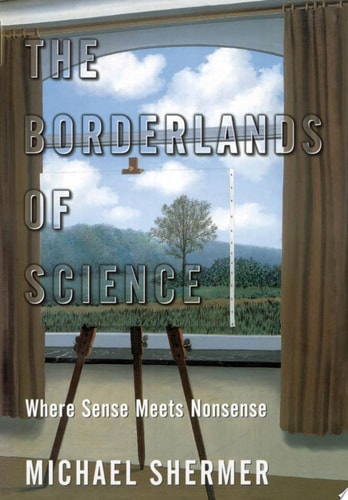
The Borderlands of Science: Where Sense Meets Nonsense
0
0
As an Amazon Associate and affiliate partner, Menrva Books earns from qualifying purchases. Learn more
Author Description
As author of the bestselling Why People Believe Weird Things and How We Believe, and Editor-in-Chief of Skeptic magazine, Michael Shermer has emerged as the nation's number one scourge of superstition and bad science. Now, in The Borderlands of Science, he takes us to the place where real science (such as the big bang theory), borderland science (superstring theory), and just plain nonsense (Big Foot) collide with one another. Shermer argues that science is the best lens through which to view the world, but he recognizes that it's often difficult for most of us to tell where valid science leaves off and borderland science begins. To help us, Shermer looks at a range of topics that put the boundary line in high relief. For instance, he discusses the many "theories of everything" that try to reduce the complexity of the world to a single principle, and shows how most fall into the category of pseudoscience. He examines the work of Darwin and Freud, explaining why one is among the great scientists in history, while the other has become nothing more than a historical curiosity. He also shows how Carl Sagan's life exemplified the struggle we all face to find a balance between being open-minded enough to recognize radical new ideas but not so open-minded that our brains fall out. And finally, he reveals how scientists themselves can be led astray, as seen in the infamous Piltdown Hoax. Michael Shermer's enlightening volume will be a valuable aid to anyone bewildered by the many scientific theories swirling about. It will help us stay grounded in common sense as we try to evaluate everything from SETI and acupuncture to hypnosis and cloning.
Menrva's Summary
THE THESIS
This work investigates the demarcation problem in science, specifically asking how individuals can distinguish between legitimate scientific inquiry, speculative borderland theories, and outright pseudoscience. Michael Shermer, as the editor-in-chief of Skeptic magazine, utilizes his background in scientific skepticism to provide a framework for evaluating claims. He argues that while science remains the most reliable method for understanding reality, the boundaries are often obscured by human cognitive biases and the complexities of emerging theories. By analyzing historical and contemporary examples, he establishes a methodology for maintaining intellectual rigor without sacrificing openness to new ideas.
THE SCOPE MAP
What You Will Find
- Analysis of the spectrum ranging from established theories like the Big Bang to fringe concepts like Bigfoot.
- Examination of the 'theories of everything' and their frequent descent into pseudoscience.
- Comparative studies of scientific figures including Darwin, Freud, and Carl Sagan.
- Case studies on scientific error and deception, such as the Piltdown Hoax.
Scope Limits
- The text does not provide an exhaustive technical manual for every scientific field mentioned.
- It focuses primarily on the philosophical and psychological aspects of scientific belief rather than deep-dive empirical data for each specific topic.
THE AUTHORITY PERSPECTIVE
Critics and readers generally view this text as a accessible primer for those interested in the philosophy of science and critical thinking. Experts often highlight the book's utility in helping laypeople navigate the often-confusing intersection of popular culture and scientific claims.
Page Count:
372
Publication Date:
2001-01-01
Publisher:
Oxford University Press
ISBN-10:
0190286636
ISBN-13:
9780190286637
Science
History
Philosophy
Earth Sciences
Skepticism
Critical thinking
Parapsychology
Pseudoscience
Philosophy of
Community Tags
Similar Books