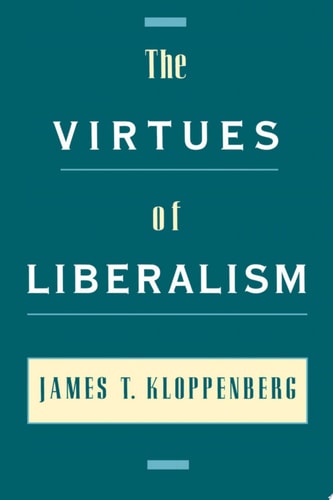
The Virtues of Liberalism
0
0
As an Amazon Associate and affiliate partner, Menrva Books earns from qualifying purchases. Learn more
Author Description
This spirited analysis--and defense--of American liberalism demonstrates the complex and rich traditions of political, economic, and social discourse that have informed American democratic culture from the seventeenth century to the present. The Virtues of Liberalism provides a convincing response to critics both right and left. Against conservatives outside the academy who oppose liberalism because they equate it with license, James T. Kloppenberg uncovers ample evidence of American republicans' and liberal democrats' commitments to ethical and religious ideals and their awareness of the difficult choices involved in promoting virtue in a culturally diverse nation. Against radical academic critics who reject liberalism because they equate it with Enlightenment reason and individual property holding, Kloppenberg shows the historical roots of American liberals' dual commitments to diversity, manifested in institutions designed to facilitate deliberative democracy, and to government regulations of property and market exchange in accordance with the public good. In contrast to prevailing tendencies to simplify and distort American liberalism, Kloppenberg shows how the multifaceted virtues of liberalism have inspired theorists and reformers from Thomas Jefferson and James Madison through Jane Addams and John Dewey to Martin Luther King, Jr., and then explains how these virtues persist in the work of some liberal democrats today. Endorsing the efforts of such neo-progressive and communitarian theorists and journalists as Michael Walzer, Jane Mansbridge, Michael Sandel, and E. J. Dionne, Kloppenberg also offers a more acute analysis of the historical development of American liberalism and of the complex reasons why it has been transformed and made more vulnerable in recent decades. An intelligent, coherent, and persuasive canvas that stretches from the Enlightenment to the American Revolution, from Tocqueville's observations to the New Deal's social programs, and from the
Menrva's Summary
THE THESIS
This work investigates the historical foundations and ethical dimensions of American liberalism to defend it against contemporary critiques from both the political right and left. James T. Kloppenberg, a historian of American intellectual life, utilizes a vast array of primary sources and political theory to argue that liberalism is not merely a philosophy of individual license or market-driven greed. Instead, he presents a framework where liberalism is deeply rooted in commitments to deliberative democracy, social responsibility, and the public good, tracing these values from the Enlightenment through the twentieth century.
THE SCOPE MAP
What You Will Find
- Historical analysis of American political thought from the seventeenth century to the modern era.
- Examination of key figures including Thomas Jefferson, James Madison, Jane Addams, John Dewey, and Martin Luther King, Jr.
- Discussion of the intersection between democratic institutions and market regulation.
Scope Limits
- The text focuses primarily on the intellectual history of the United States rather than a comprehensive global history of liberalism.
- It does not provide a prescriptive policy manual for current governance but rather an intellectual defense of the liberal tradition.
THE AUTHORITY PERSPECTIVE
Scholars and political commentators frequently cite this work as a rigorous intellectual history that challenges common misconceptions about the American political tradition. Readers often note the academic density of the prose, which requires a foundational understanding of American political history to fully appreciate the author's arguments.
Page Count:
244
Publication Date:
1998-01-01
Publisher:
Oxford University Press
ISBN-10:
0190283920
ISBN-13:
9780190283926
History
American History
Conservatism & Liberalism
Liberalism
Political Philosophy
Community Tags
Other Editions(4)



Similar Books















Reader Comments
Share Your Thoughts
No comments yet. Be the first to share your thoughts!