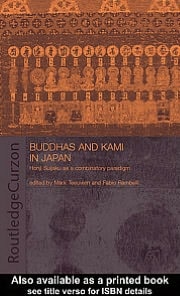
Buddhas and Kami in Japan: Honji Suijaku As a Combinatory Paradigm
0
0
As an Amazon Associate and affiliate partner, Menrva Books earns from qualifying purchases. Learn more
Author Description
This volume offers a multidisciplinary approach to the combinatory tradition that dominated premodern and early modern Japanese religion, known as honji suijaku (originals and their traces). It questions received, simplified accounts of the interactions between Shinto and Japanese Buddhism, and presents a more dynamic and variegated religious world, one in which the deities' Buddhist originals and local traces did not constitute one-to-one associations, but complex combinations of multiple deities based on semiotic operations, doctrines, myths, and legends. The book's essays, all based on specific case studies, discuss the honji suijaku paradigm from a number of different perspectives, always integrating historical and doctrinal analysis with interpretive insights.
Menrva's Summary
THE THESIS
This volume investigates the complex religious paradigm of honji suijaku to determine how premodern Japanese religious traditions integrated Buddhist deities with local kami. The authors, Fabio Rambelli and Mark Teeuwen, curate a collection of essays that challenge traditional, binary interpretations of Shinto and Buddhism. By utilizing historical, doctrinal, and semiotic analysis, the contributors argue that the relationship between these traditions was not a simple one-to-one correspondence but a fluid, multifaceted system of theological and mythological synthesis.
THE SCOPE MAP
What You Will Find
- Analysis of the honji suijaku paradigm as a semiotic and doctrinal framework.
- Case studies examining specific interactions between Buddhist originals and local kami traces.
- Integration of historical, mythological, and legend-based evidence.
- Exploration of the dynamic, non-linear nature of premodern Japanese religious identity.
THE AUTHORITY PERSPECTIVE
Scholars and historians of Japanese religion regard this work as a significant contribution to the study of syncretism, often citing its ability to move beyond simplified historical narratives. The text is frequently noted for its academic rigor and its utility as a foundational resource for those studying the intersection of Shinto and Buddhist thought.
Page Count:
0
Publication Date:
2003-01-01
Publisher:
Taylor & Francis Group
ISBN-10:
0203220250
ISBN-13:
9780203220252
Philosophy
History
Religion
Shinto
Buddhism relations shinto
Buddhism
Japanese History
Shinto relations buddhism
Community Tags
Similar Books