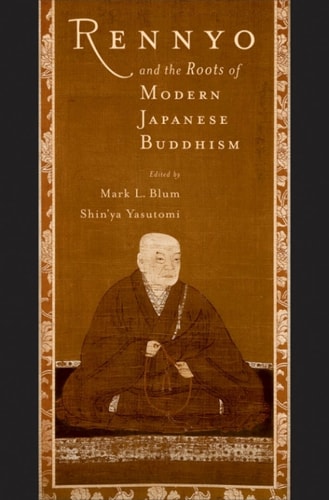
Rennyo and the Roots of Modern Japanese Buddhism
0
0
As an Amazon Associate and affiliate partner, Menrva Books earns from qualifying purchases. Learn more
Author Description
Rennyo Shonin (1415-1499) is considered the "second founder" of Shin Buddhism. Under his leadership, the Honganji branch grew in size and power, becoming a national organization with great wealth and influence. Rennyo's success lay in conveying an attractive spiritual message while exerting effective administrative control. A savvy politician as well as religious leader, ennyo played a significant role in political, economic, and institutional developments. Though he is undeniably one of the most influential persons in the history of Japanese religion, his legacy remains enigmatic and largely overlooked by the West. This volume offers an assessment of Rennyo's contribution to Buddhist thought and the Honganji religious organization. A collection of 16 previously unpublished essays by both Japanese and non-Japanese scholars in the areas of historical studies, Shinshu studies, and comparative religion, it is the first book to confront many of the major questions surrounding the phenomenal growth of Honganji under Rennyo's leadership. The authors examine such topics as the source of Rennyo's charisma, the soteriological implications of his thought against the background of other movements in Pure Land Buddhism, and the relationship between his ideas and the growth of his church. This collection is an important first step in bringing this important figure to an audience outside Japan. It will be of significant interest to scholars in the fields of Japanese religion, Japanese social history, comparative religion, and the sociology of religion.
Menrva's Summary
THE THESIS
This volume investigates the historical, administrative, and theological mechanisms that allowed Rennyo Shonin to transform the Honganji branch into a dominant national religious organization in 15th-century Japan. Edited by Mark L. Blum and Shin'ya Yasutomi, the text compiles sixteen scholarly essays that analyze Rennyo's dual role as a charismatic religious leader and a pragmatic political strategist. By synthesizing historical data with theological inquiry, the contributors provide a comprehensive framework for understanding how Rennyo's leadership influenced the institutional trajectory of Shin Buddhism.
THE SCOPE MAP
What You Will Find
- Historical analysis of the Honganji branch's expansion during the 15th century.
- Examination of Rennyo's administrative strategies and political influence.
- Comparative studies of Pure Land Buddhist thought and soteriological implications.
- Scholarly essays addressing the intersection of religious charisma and institutional growth.
THE AUTHORITY PERSPECTIVE
Experts identify this collection as a foundational academic resource for those studying the history of Japanese religion and the development of Shinshu. Readers frequently note the academic density of the prose, which serves as a rigorous introduction to a figure previously under-examined in Western scholarship.
Page Count:
320
Publication Date:
2005-01-01
Publisher:
Oxford University Press
ISBN-10:
0195350995
ISBN-13:
9780195350999
Religion
History
Sociology of Religion
Asian History
Buddhist Sects
Japanese History
Buddhism
Community Tags
Other Editions(2)

Similar Books