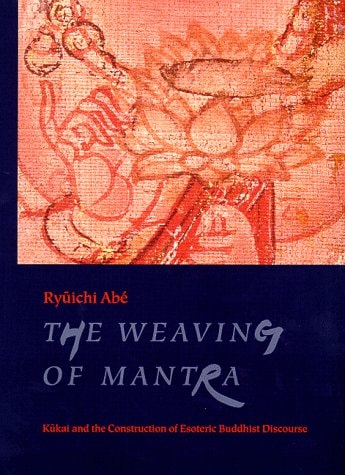
The Weaving of Mantra: Kūkai and the Construction of Esoteric Buddhist Discourse
0
0
As an Amazon Associate and affiliate partner, Menrva Books earns from qualifying purchases. Learn more
Author Description
The Buddhist priest Kukai (774-835) is credited with the introduction and formal establishment of tantric -- or esoteric -- Buddhism in early ninth-century Japan and the founding of the Shingon school. In The Weaving of Mantra, author Ryuichi Abe examines this important religious figure -- neglected in modern academic literature -- and his profound influence on Japanese culture. Offering a radically new approach to the study of early religious history -- combining historical research, discourse analysis, literary criticism, and semiology -- Abe contends that the importance of Kukai's establishment of esoteric Buddhism lay not in the foundation of the Shingon sect but in his creation of a general theory of language grounded in the ritual speech of mantra. The Weaving of Mantra embeds Kukai within the fabric of political and social life in ninth-century Japan and explains how esoteric Buddhism played a critical role in many societal changes in Japan -- from the growth of monasteries into major feudal powers to the formation of the native phonetic alphabet, kana. As Abe illustrates, Kukai's writings and the new type of discourse they spawned also marked Japan's transition from the ancient order to the medieval world, replacing Confucianism as the ideology of the state. Abe begins by placing Kukai's life in the historical context of medieval Japan and the ritsuryo state, then explores his interaction with the Nara Buddhist intelligentsia, which was seminal to the invention of esoteric Buddhism; discusses his magnum opus, Ten Abiding Stages on the Secret Mandalas (Himitsu mandara jujushinron); and introduces a number of Japanese and Chinese primary-source texts previously unknown byWestern-language scholars. Instead of tracing Kukai's thought through literal readings, The Weaving of Mantra explores the rhetorical strategies Kukai employed in his works, shedding valuable light on what his texts meant to his readers and what his goals were in creating a discourse that
Menrva's Summary
THE THESIS
This book investigates the profound influence of the Buddhist priest Kūkai on Japanese culture, focusing on his introduction of esoteric Buddhism and his creation of a new theory of language grounded in mantra. The author, Ryūichi Abe, a scholar of religious history, examines Kūkai, a figure often neglected in modern academic literature, and his role in shaping ninth-century Japan. Abe's approach integrates historical research, discourse analysis, literary criticism, and semiology to argue that Kūkai's significance lies not in founding the Shingon sect but in his theoretical framework for language. The work situates Kūkai within the political and social landscape of his time, demonstrating how esoteric Buddhism influenced societal changes, monastic power, and the development of the Japanese phonetic alphabet.
THE SCOPE MAP
- The historical context of Kūkai's life within medieval Japan and the ritsuryō state.
- Kūkai's interactions with the Nara Buddhist intelligentsia and the invention of esoteric Buddhism.
- An in-depth exploration of Kūkai's magnum opus, 'Ten Abiding Stages on the Secret Mandalas' (Himitsu mandara jujushinron).
- Introduction to Japanese and Chinese primary-source texts previously unfamiliar to Western scholars.
- Analysis of Kūkai's rhetorical strategies and the intended meaning of his texts for his readers.
- The role of esoteric Buddhism in societal transformations, including the rise of monastic feudal powers and the formation of the kana alphabet.
- Kūkai's discourse as a marker of Japan's transition from the ancient to the medieval world, supplanting Confucianism as state ideology.
THE AUTHORITY PERSPECTIVE
The book is recognized for its innovative approach to early religious history, combining multiple analytical methods to re-evaluate the significance of Kūkai. Scholars have noted its detailed examination of primary sources and its focus on Kūkai's theoretical contributions to language and discourse. The work is considered a significant contribution to the study of Japanese Buddhism and its cultural impact.
Page Count:
593
Publication Date:
1999-01-01
Publisher:
Columbia University Press
ISBN-10:
0231112866
ISBN-13:
9780231112864
Non-Fiction
History
Religion
Philosophy
Discourse Analysis
Buddhism
Cultural History
Japanese History
Community Tags
Similar Books