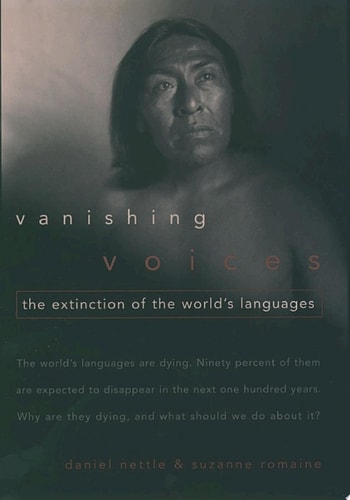
Vanishing Voices: The Extinction of the World's Languages
0
0
As an Amazon Associate and affiliate partner, Menrva Books earns from qualifying purchases. Learn more
Author Description
Few people know that nearly 100 native languages once spoken in what is now California are near extinction, or that most of Australia's 250 aboriginal languages have vanished. In fact, at least half of the world's languages may die out in the next century. What has happened to these voices? Should we be alarmed about the disappearance of linguistic diversity? The authors of Vanishing Voices assert that this trend is far more than simply disturbing. Making explicit the link between language survival and environmental issues, they argue that the extinction of languages is part of the larger picture of near-total collapse of the worldwide ecosystem. Indeed, the authors contend that the struggle to preserve precious environmental resources-such as the rainforest-cannot be separated from the struggle to maintain diverse cultures, and that the causes of language death, like that of ecological destruction, lie at the intersection of ecology and politics. And while Nettle and Romaine defend the world's endangered languages, they also pay homage to the last speakers of dying tongues, such as Red Thundercloud, a Native American in South Carolina, Ned Mandrell, with whom the Manx language passed away in 1974, and Arthur Bennett, an Australian, the last person to know more than a few words of Mbabaram. In our languages lies the accumulated knowledge of humanity. Indeed, each language is a unique window on experience. Vanishing Voices is a call to preserve this resource, before it is too late.
Menrva's Summary
THE THESIS
This book investigates the rapid decline of global linguistic diversity and its direct correlation to the broader collapse of worldwide ecosystems. Daniel Nettle and Suzanne Romaine, both established scholars in linguistics, utilize historical data and ecological analysis to argue that language extinction is not an isolated phenomenon. They posit that the forces driving the loss of indigenous languages are inextricably linked to the political and environmental pressures that threaten global biodiversity.
THE SCOPE MAP
What You Will Find
- Historical analysis of language loss in regions such as California and Australia
- A theoretical framework linking linguistic diversity to ecological health
- Case studies of individual speakers representing the final generation of specific tongues
Scope Limits
- The text does not provide a comprehensive manual for language revitalization techniques
- It does not focus on the evolution of dominant global languages like English or Mandarin
THE AUTHORITY PERSPECTIVE
Scholars and linguists frequently cite this work as a foundational text for understanding the intersection of biolinguistic diversity and environmental conservation. Readers often note the accessible yet rigorous nature of the prose, which effectively bridges the gap between academic research and public awareness.
Page Count:
251
Publication Date:
2000-01-01
Publisher:
Oxford University Press
ISBN-10:
0190285788
ISBN-13:
9780190285784
Politics
Kindle Store
Cultural Anthropology
Words Language & Grammar
Categories
NATURE Ecology
Reference
Sociology
Conservation
Environment
Kindle eBooks
Anthropology
English
English & College Success
Linguistics
Ecology