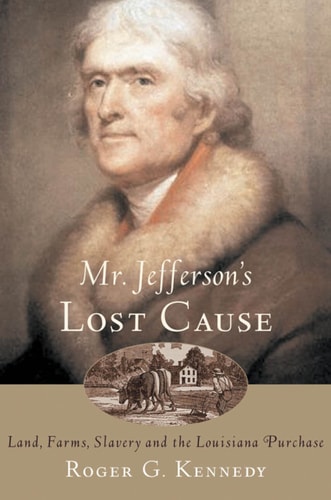
Mr. Jefferson's Lost Cause: Land, Farmers, Slavery, and the Louisiana Purchase
0
0
As an Amazon Associate and affiliate partner, Menrva Books earns from qualifying purchases. Learn more
Author Description
Thomas Jefferson advocated a republic of small farmers--free and independent yeomen. And yet as president he presided over a massive expansion of the slaveholding plantation system, particularly with the Louisiana Purchase, squeezing the yeomanry to the fringes and to less desirable farmland. Now Roger G. Kennedy conducts an eye-opening examination of the gap between Jefferson's stated aspirations and what actually happened. Kennedy reveals how the Louisiana Purchase had a major impact on land use and the growth of slavery. He examines the great financial interests (such as the powerful land companies that speculated in new territories and the British textile interests) that beat down slavery's many opponents in the South itself (Native Americans, African Americans, Appalachian farmers, and conscientious opponents of slavery). He describes how slaveholders' cash crops--first tobacco, then cotton--sickened the soil and how the planters moved from one desolated tract to the next. Soon the dominant culture of the entire region--from Maryland to Florida, from Carolina to Texas--was that of owners and slaves producing staple crops for international markets. The earth itself was impoverished, in many places beyond redemption. None of this, Kennedy argues, was inevitable. He focuses on the character, ideas, and ambitions of Thomas Jefferson to show how he and other Southerners struggled with the moral dilemmas presented by the presence of Indian farmers on land they coveted, by the enslavement of their workforce, by the betrayal of their stated hopes, and by the manifest damage being done to the earth itself. Jefferson emerges as a tragic figure in a tragic period. Mr. Jefferson's Lost Cause was a CHOICE Outstanding Academic Title for 2003.
Menrva's Summary
THE THESIS
This work investigates the contradiction between Thomas Jefferson’s vision of a republic of independent yeoman farmers and the historical reality of the expansion of the slaveholding plantation system during his presidency. Roger G. Kennedy, a former director of the National Park Service, utilizes extensive historical records and land-use data to argue that the Louisiana Purchase facilitated the growth of large-scale plantation agriculture at the expense of small farmers and the environment. He posits that the dominance of slave-based cash crops was not an inevitable outcome but a result of specific political and financial choices made by Jefferson and his contemporaries.
THE SCOPE MAP
What You Will Find
- Analysis of land speculation companies and their influence on territorial expansion.
- Examination of the environmental impact of tobacco and cotton monoculture.
- Historical assessment of the displacement of Native American farmers and Appalachian settlers.
- Investigation into the intersection of British textile markets and Southern slave labor.
Scope Limits
- The text does not provide a comprehensive biography of Jefferson, focusing primarily on his political and economic policies regarding land and slavery.
- It does not cover the entirety of the antebellum period, concentrating specifically on the era surrounding the Louisiana Purchase.
THE AUTHORITY PERSPECTIVE
Historians and scholars recognize this work as a significant contribution to the study of early American economic and environmental history. Readers frequently note the dense, analytical nature of the prose, which provides a critical counter-narrative to traditional interpretations of Jeffersonian democracy.
Page Count:
368
Publication Date:
2003-01-01
Publisher:
Oxford University Press
ISBN-10:
0190288426
ISBN-13:
9780190288426
Biography
History
Slavery
Political History
United States
American History
Agriculture
Family Farms
Community Tags
Similar Books