
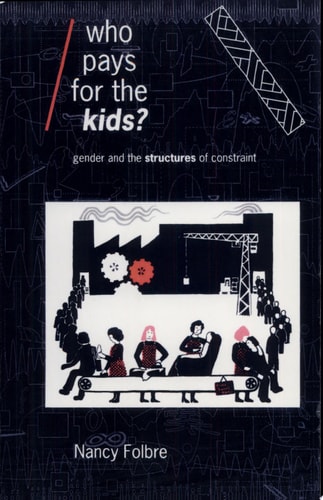
Who Pays for the Kids?
0
0
As an Amazon Associate and affiliate partner, Menrva Books earns from qualifying purchases. Learn more
Author Description
Nancy Folbre focuses on questions that most economists never think about: how and why people form overlapping groups that influence and limit what they want, how they may behave, and what they get. She has sharp and plausible things to say about group solidarity and group conflict and how they have affected the workings of economic institutions. Anyone would be a better economist, or just a clearer thinker, after reading this book.'- Robert M. Solow, Professor of Economics, MIT and Nobel Laureate in EconomicsWho Pays for the Kids? is the short version of the longer question: How are the costs of caring for ourselves,, our children, and other dependents are distributed among the members of society? These costs are largely paid by women, both inside and outside the money economy. They also seem to be increasing, due to the expansion of wage employment, the increased importance of education, and improved health technologies. Despite the social programmes of the welfare state, parents with young children, especially mothers on their own, are increasingly susceptible to poverty.How can we explain the distribution of the `costs of caring' between men and women, parents and children, parents and non-parents? Traditional neoclassical economics answers this question by emphasizing personal choice. Traditional Marxian economics answers it by emphasizing class interest. Traditional feminist theory answers it by emphasizing gender interests. Arguing that all these answers are incomplete, this book offers an alternative analysis of individual choices within interlocking structures of constraint based on gender, age, sex, nation, race and class. A comparative history of this interaction in Northwestern Europe, the United States and the Caribbean helps explain differences in political movements, state policies, and social welfare.Written in a fresh and energetic style by a well known feminist economist, Who Pays for the Kids? is an excellent text for upper level courses in women's studies and economics.
Menrva's Summary
THE THESIS
This book investigates the systemic distribution of the costs associated with caring for dependents and how these economic burdens are allocated across gender, class, and social structures. Nancy Folbre, a prominent feminist economist, challenges the limitations of neoclassical, Marxian, and traditional feminist economic models. By synthesizing these perspectives, she proposes a framework that accounts for individual choices operating within interlocking constraints of gender, age, race, and nation. Her analysis utilizes historical and comparative data from Northwestern Europe, the United States, and the Caribbean to illustrate how these social dynamics shape welfare policies and economic outcomes.
THE SCOPE MAP
What You Will Find
- Comparative historical analysis of care-related economic policies in Northwestern Europe, the United States, and the Caribbean.
- A multi-dimensional framework for analyzing individual economic behavior within structures of gender, age, and class.
- Critique of traditional economic theories regarding the distribution of care costs.
- Examination of the impact of wage employment, education, and health technology on the financial burden of child-rearing.
THE AUTHORITY PERSPECTIVE
Experts and economists recognize this work as a significant contribution to the intersection of feminist theory and institutional economics. Readers frequently note the clarity of the author's prose, which makes complex socioeconomic arguments accessible for both academic and general audiences.
Page Count:
352
Publication Date:
2004-01-01
Publisher:
Taylor & Francis Inc
ISBN-10:
0203263480
ISBN-13:
9780203263488
Economics
Trabalho
Social Welfare
Social Aspects
Social Science
Industry
Feminist Theory
Sociology
Gender Studies
Nonfiction
Community Tags
Other Editions(2)
Similar Books













Reader Comments
Share Your Thoughts
No comments yet. Be the first to share your thoughts!