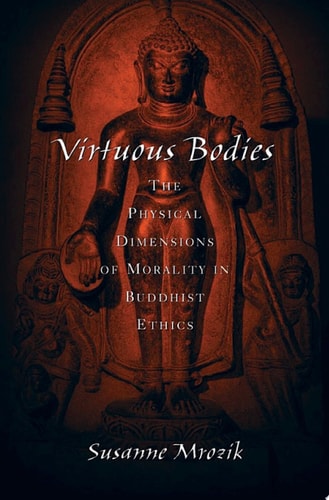
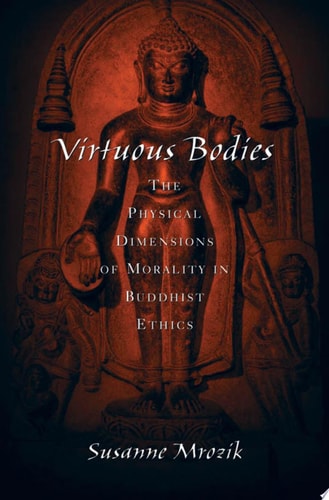
Virtuous Bodies: The Physical Dimensions of Morality in Buddhist Ethics
0
0
As an Amazon Associate and affiliate partner, Menrva Books earns from qualifying purchases. Learn more
Author Description
Virtuous Bodies breaks new ground in the field of Buddhist ethics by investigating the diverse roles bodies play in ethical development. Traditionally, Buddhists assumed a close connection between body and morality. Thus Buddhist literature contains descriptions of living beings that stink with sin, are disfigured by vices, or are perfumed and adorned with virtues. Taking an influential early medieval Indian Mahāyāna Buddhist text-Śāntideva's Compendium of Training (Śikşāsamuccaya)-as a case study, Susanne Mrozik demonstrates that Buddhists regarded ethical development as a process of physical and moral transformation. Mrozik chooses The Compendium of Training because it quotes from over one hundred Buddhist scriptures, allowing her to reveal a broader Buddhist interest in the ethical significance of bodies. The text is a training manual for bodhisattvas, especially monastic bodhisattvas. In it, bodies function as markers of, and conditions for, one's own ethical development. Most strikingly, bodies also function as instruments for the ethical development of others. When living beings come into contact with the virtuous bodies of bodhisattvas, they are transformed physically and morally for the better. Virtuous Bodies explores both the centrality of bodies to the bodhisattva ideal and the corporeal specificity of that ideal. Arguing that the bodhisattva ideal is an embodied ethical ideal, Mrozik poses an array of fascinating questions: What does virtue look like? What kinds of physical features constitute virtuous bodies? What kinds of bodies have virtuous effects on others? Drawing on a range of contemporary theorists, this book engages in a feminist hermeneutics of recovery and suspicion in order to explore the ethical resources Buddhism offers to scholars and religious practitioners interested in the embodied nature of ethical ideals.
Menrva's Summary
THE THESIS
This book investigates the intersection of physical form and moral status within Buddhist ethics, specifically focusing on how the body serves as both a marker and an instrument of ethical development. Susanne Mrozik, a scholar of Buddhist studies, utilizes Śāntideva's Compendium of Training as a primary case study to analyze how Mahāyāna Buddhist texts conceptualize the relationship between physical appearance and virtue. By examining the text's extensive citations of earlier scriptures, Mrozik argues that the bodhisattva ideal is fundamentally an embodied one, where physical transformation is inseparable from moral progress.
THE SCOPE MAP
What You Will Find
- Analysis of Śāntideva's Compendium of Training as a primary source.
- Application of feminist hermeneutics to classical Buddhist texts.
- Exploration of the bodhisattva ideal within monastic contexts.
- Examination of the body as an instrument for influencing the moral development of others.
Scope Limits
- The study focuses primarily on early medieval Indian Mahāyāna traditions rather than a comprehensive survey of all Buddhist schools.
- The analysis is restricted to the specific ethical framework presented in the Śikşāsamuccaya.
THE AUTHORITY PERSPECTIVE
Scholars in the field of religious studies identify this work as a significant contribution to the study of embodiment in Buddhist ethics. Readers frequently note the academic density of the prose and the author's rigorous application of contemporary critical theory to classical monastic texts.
Page Count:
194
Publication Date:
2007-01-01
Publisher:
Oxford University Press
ISBN-10:
0190294019
ISBN-13:
9780190294014
Philosophy
Religion
Gender Studies
Ethics
Buddhism
Eastern
Body Studies
Community Tags
Other Editions(2)

Similar Books









Reader Comments
Share Your Thoughts
No comments yet. Be the first to share your thoughts!