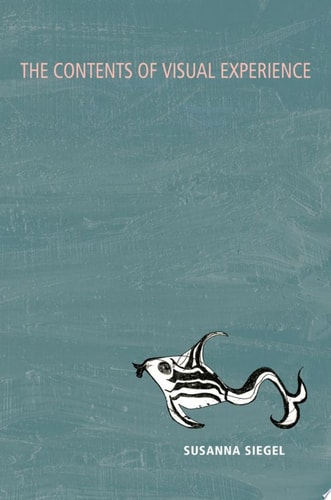
The Contents of Visual Experience
0
0
As an Amazon Associate and affiliate partner, Menrva Books earns from qualifying purchases. Learn more
Author Description
What do we see? We are visually conscious of colors and shapes, but are we also visually conscious of complex properties such as being John Malkovich? In this book, Susanna Siegel develops a framework for understanding the contents of visual experience, and argues that these contents involve all sorts of complex properties. Siegel starts by analyzing the notion of the contents of experience, and by arguing that theorists of all stripes should accept that experiences have contents. She then introduces a method for discovering the contents of experience: the method of phenomenal contrast. This method relies only minimally on introspection, and allows rigorous support for claims about experience. She then applies the method to make the case that we are conscious of many kinds of properties, of all sorts of causal properties, and of many other complex properties. She goes on to use the method to help analyze difficult questions about our consciousness of objects and their role in the contents of experience, and to reconceptualize the distinction between perception and sensation. Siegel's results are important for many areas of philosophy, including the philosophy of mind, epistemology, and the philosophy of science. They are also important for the psychology and cognitive neuroscience of vision.
Menrva's Summary
THE THESIS
This book investigates the extent and nature of the properties represented in visual experience. Susanna Siegel, a professor of philosophy, utilizes a systematic framework to argue that visual perception includes complex properties beyond simple colors and shapes. She introduces the method of phenomenal contrast to provide a rigorous, minimally introspective approach for determining what is present in our conscious visual field.
THE SCOPE MAP
What You Will Find
- The method of phenomenal contrast for analyzing visual content
- Arguments for the inclusion of complex and causal properties in perception
- Analysis of the relationship between objects and visual contents
- Reconceptualization of the distinction between perception and sensation
Scope Limits
- Does not provide a comprehensive biological account of the visual cortex
- Does not address non-visual sensory modalities in depth
THE AUTHORITY PERSPECTIVE
Experts in philosophy of mind and cognitive science recognize this work as a significant contribution to the debate regarding the representational content of perception. Readers frequently note the technical density of the prose, which is intended for an academic audience familiar with analytic philosophy.
Page Count:
232
Publication Date:
2011-01-01
Publisher:
Oxford University Press
ISBN-10:
0190294051
ISBN-13:
9780190294052
Philosophy
Experience
Epistemology
Mind & Body
Perception
Philosophy of
Vision
Community Tags
Other Editions(3)

Similar Books