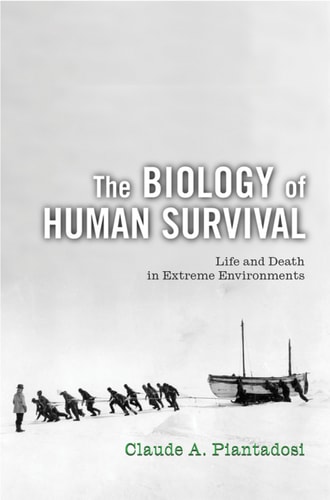
The Biology of Human Survival: Life and Death in Extreme Environments
0
0
As an Amazon Associate and affiliate partner, Menrva Books earns from qualifying purchases. Learn more
Author Description
The range of environments in which people can survive is extensive, yet most of the natural world cannot support human life. The Biology of Human Survival identifies the key determinants of life or death in extreme environments from a physiologist's perspective, integrating modern concepts of stress, tolerance, and adaptation into explanations of life under Nature's most austere conditions. The book examines how individuals survive when faced with extremes of immersion, heat, cold or altitude, emphasizing the body's recognition of stress and the brain's role in optimizing physiological function in order to provide time to escape or to adapt. In illustrating how human biology adapts to extremes, the book also explains how we learn to cope by blending behavior and biology, first by trial and error, then by rigorous scientific observation, and finally by technological innovation. The book describes life-support technology and how it enables humans to enter once unendurable realm, from the depths of the ocean to the upper reaches of the atmosphere and beyond. Finally, it explores the role that advanced technology might play in special environments of the future, such as long journeys into space.
Menrva's Summary
THE THESIS
This book investigates the physiological and behavioral mechanisms that allow human beings to survive in environments that are otherwise hostile to life. Claude A. Piantadosi, a medical doctor and expert in hyperbaric medicine, utilizes a framework of stress response, tolerance, and adaptation to explain how the human body maintains homeostasis under extreme conditions. By synthesizing biological data with historical and technological advancements, the author argues that human survival is a result of the brain's ability to optimize physiological function alongside the development of life-support systems.
THE SCOPE MAP
What You Will Find
- Analysis of physiological responses to heat, cold, high altitude, and deep-sea immersion.
- Examination of the brain's role in stress recognition and metabolic regulation.
- Historical overview of how humans transitioned from trial-and-error survival to scientific and technological mastery.
- Discussion of future survival requirements for long-duration space exploration.
Scope Limits
- The text does not provide a comprehensive medical manual for emergency medicine or first aid.
- It does not focus on psychological trauma or the sociological aspects of survival in extreme conditions.
THE AUTHORITY PERSPECTIVE
Experts and readers frequently note the academic density of the prose, which balances rigorous physiological detail with accessible explanations of human adaptation. It is widely regarded as a foundational text for those interested in the intersection of human biology and extreme environment engineering.
Page Count:
278
Publication Date:
2003-01-01
Publisher:
Oxford University Press
ISBN-10:
0190290021
ISBN-13:
9780190290023
Science
Biology
Technology
Medical
Physiology
Allied Health
Adaptation Biology
Community Tags
Similar Books