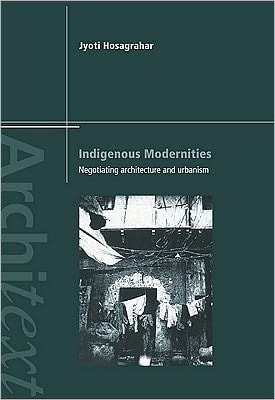
Indigenous Modernities: Negotiating Architecture, Urbanism, and Colonialism in Delhi
0
0
As an Amazon Associate and affiliate partner, Menrva Books earns from qualifying purchases. Learn more
Author Description
This book examines how a historic and so-called 'traditional' city quietly evolved into one that was modern in its own terms; in form, use and meaning. Through a focused study of Delhi, the author challenges prevalent assumptions in architecture and urbanism to identify an interpretation of modernism that goes beyond conventional understanding. Part one reflects on transformations and discontinuities in built form and spatial culture and questions accepted notions of the static nature of what is normally referred to as traditional and non-Western architecture. Part two is a critical discussion of Delhi in the nineteenth and early twentieth centuries, redefining modernism in a way that separates the city's architecture and society from the objectified realm of the exotic whilst acknowledging non-Western ideas of modernity. In the final part the author considers 'indigenous modernities': the irregular, the uneven and the unexpected in what uncritical observers might call a coherent 'traditional' society and built environment.
Menrva's Summary
THE THESIS
This book investigates how Delhi evolved into a modern city through its own unique architectural and urban transformations, challenging the binary between traditional and Western-modern forms. Jyoti Hosagrahar, an expert in architectural history and urban design, utilizes archival research and spatial analysis to argue that modernity in non-Western contexts is not a derivative of colonial influence but an indigenous process. She presents a framework that redefines modernism by focusing on the irregular and uneven development of Delhi's built environment during the nineteenth and early twentieth centuries.
THE SCOPE MAP
What You Will Find
- Analysis of architectural transformations in Delhi during the nineteenth and early twentieth centuries.
- A critical framework for understanding indigenous modernities beyond Western-centric definitions.
- Examination of spatial culture and the evolution of built forms in a non-Western urban context.
- Re-evaluation of the concept of 'traditional' architecture as a dynamic, rather than static, entity.
THE AUTHORITY PERSPECTIVE
Scholars in urban studies and architectural history frequently cite this work for its nuanced critique of colonial-era urban planning and its contribution to postcolonial theory. Readers often note the academic density of the prose, which serves as a foundational text for those studying the intersection of culture, space, and modernity in South Asia.
Page Count:
234
Publication Date:
2005-01-01
Publisher:
Routledge
ISBN-10:
0415323754
ISBN-13:
9780203356784
History
Architecture
Urbanism
Sociology
Architecture india
India - History
City Planning
Community Tags
Similar Books