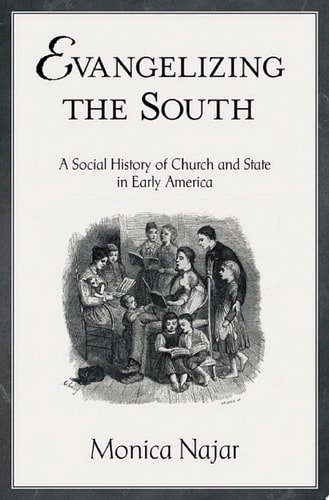
Evangelizing the South: A Social History of Church and State in Early America
0
0
As an Amazon Associate and affiliate partner, Menrva Books earns from qualifying purchases. Learn more
Author Description
Although many refer to the American South as the "Bible Belt", the region was not always characterized by a powerful religious culture. In the seventeenth century and early eighteenth century, religion-in terms both of church membership and personal piety-was virtually absent from southern culture. The late eighteenth century and early nineteenth century, however, witnessed the astonishingly rapid rise of evangelical religion in the Upper South. Within just a few years, evangelicals had spread their beliefs and their fervor, gaining converts and building churches throughout Virginia and North Carolina and into the western regions. But what was it that made evangelicalism so attractive to a region previously uninterested in religion? Monica Najar argues that early evangelicals successfully negotiated the various challenges of the eighteenth-century landscape by creating churches that functioned as civil as well as religious bodies. The evangelical church of the late eighteenth century was the cornerstone of its community, regulating marriages, monitoring prices, arbitrating business, and settling disputes. As the era experienced substantial rifts in the relationship between church and state, the disestablishment of colonial churches paved the way for new formulations of church-state relations. The evangelical churches were well-positioned to provide guidance in uncertain times, and their multiple functions allowed them to reshape many of the central elements of authority in southern society. They assisted in reformulating the lines between the "religious" and "secular" realms, with significant consequences for both religion and the emerging nation-state. Touching on the creation of a distinctive southern culture, the position of women in the private and public arenas, family life in the Old South, the relationship between religion and slavery, and the political culture of the early republic, Najar reveals the history behind a religious heritage that remains a distinguishing feature of the region.
Menrva's Summary
THE THESIS
This book investigates how evangelical churches in the Upper South transformed from marginal groups into central pillars of social and political authority during the late eighteenth and early nineteenth centuries. Monica Najar, a historian specializing in American religious history, utilizes primary source records from early evangelical congregations to argue that these churches succeeded by functioning as both religious and civil institutions. By regulating community life and arbitrating disputes, these organizations effectively filled the vacuum left by the disestablishment of colonial churches and helped define the boundaries between religious and secular spheres in the early American republic.
THE SCOPE MAP
What You Will Find
- Analysis of the rapid expansion of evangelicalism in Virginia and North Carolina.
- Examination of church roles in marriage regulation, price monitoring, and dispute resolution.
- Discussion of the intersection between religion, slavery, and gender roles in the Old South.
- Historical context regarding the shift in church-state relations during the post-colonial era.
Scope Limits
- The study focuses primarily on the Upper South and does not provide a comprehensive analysis of the entire American South or later nineteenth-century developments.
THE AUTHORITY PERSPECTIVE
Scholars frequently cite this work for its detailed archival research into the administrative functions of early evangelical congregations. Experts highlight this as a significant contribution to understanding how religious institutions shaped the social and political infrastructure of the early United States.
Page Count:
264
Publication Date:
2008-01-01
Publisher:
Oxford University Press
ISBN-10:
0190294817
ISBN-13:
9780190294816
Religion
History
American History
Social History
Evangelicalism
Church & State
Modern History
Community Tags
Other Editions(2)

Similar Books








Reader Comments
Share Your Thoughts
No comments yet. Be the first to share your thoughts!