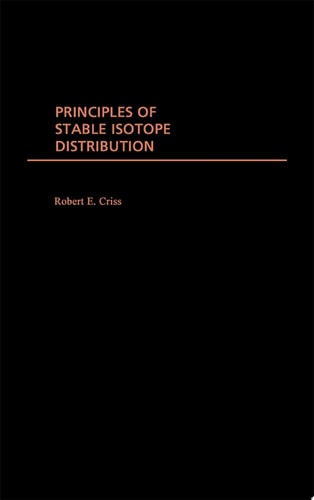
Principles of Stable Isotope Distribution
0
0
As an Amazon Associate and affiliate partner, Menrva Books earns from qualifying purchases. Learn more
Author Description
This book presents a quantitative treatment of the theory and natural variations of light stable isotopes. It discusses isotope distribution in the context of fractionation processes, thermodynamics, mass conservation, exchange kinetics, and diffusion theory, and includes more than 100 original equations. The theoretical principles are illustrated with natural examples that emphasize oxygen and hydrogen isotope variations in natural waters, terrestrial and extraterrestrial rocks, and hydrothermal systems. New data on meteoric precipitation, rivers, springs, formation fluids, and hydrothermal systems are included in relation to various natural phenomena. Essentially, this book seeks to reconnect the diverse phenomenological observations of isotope distribution to the quantitative theories of physical chemistry and the language of differential equations. It may serve as a textbook for advanced students, as a research reference, or as a quick source of information. The book is organized into five chapters, each followed by suggested quantitative problems and a short reference list. The three theoretical chapters progress from an elementary review of the physical chemistry of stable isotopes, to the thermodynamics of isotopic compounds, and finally to the calculation of isotope distribution in dynamic systems. The third and fifth chapters emphasize oxygen and hydrogen isotope variations in Earth's hydrosphere and lithosphere, constituting the most important examples of the theoretical principles. Appendices provide data on atomic weights of light elements, physical constants, mathematical relationships, and isotopic fractionation factors.
Menrva's Summary
THE THESIS
This book investigates the quantitative theoretical principles governing the distribution and natural variations of light stable isotopes within physical and chemical systems. Robert E. Criss, a specialist in geochemistry, utilizes a framework rooted in thermodynamics, mass conservation, and differential equations to bridge the gap between phenomenological observations and rigorous physical chemistry. The text provides a systematic approach to calculating isotopic behavior in both static and dynamic environments, drawing heavily on data from the hydrosphere and lithosphere.
THE SCOPE MAP
What You Will Find
- Quantitative treatment of fractionation processes, exchange kinetics, and diffusion theory.
- Theoretical models for oxygen and hydrogen isotope variations in natural waters and rocks.
- Over 100 original equations and structured problem sets for advanced study.
Scope Limits
- The text focuses primarily on light stable isotopes and does not provide an exhaustive survey of all isotopic systems.
- It assumes a foundational understanding of physical chemistry and calculus.
THE AUTHORITY PERSPECTIVE
Experts recognize this work as a rigorous, mathematically-driven resource for researchers and advanced students in geochemistry. Readers frequently note the high density of the prose and the utility of the included problem sets for mastering complex isotopic calculations.
Page Count:
264
Publication Date:
1999-01-01
Publisher:
Oxford University Press
ISBN-10:
0190283580
ISBN-13:
9780190283582
Science
Geochemistry
Geophysics
Isotopes
Earth Science
Earth Sciences
Geology
Physical Chemistry
Isotope Geology
Academic