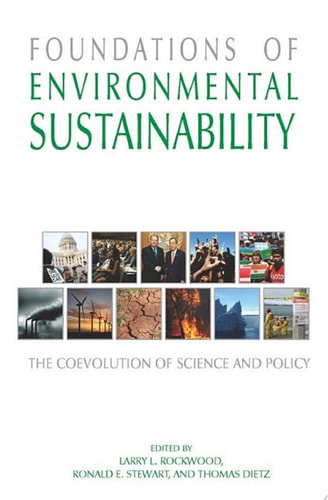
Foundations of Environmental Sustainability: The Coevolution of Science and Policy
0
0
As an Amazon Associate and affiliate partner, Menrva Books earns from qualifying purchases. Learn more
Author Description
This book reviews and analyzes the period (roughly from the 1950s to the present) when the "environment" became an issue as important as economic growth, or war and peace; to assess the current situation, and begin planning for the challenges that lie ahead. Most people are aware of both the environmental destruction taking place around the world and of the specter of climate change. The devastation of New Orleans by hurricane Katrina illustrates the potential for disaster when climate change is combined with the mismanaged environmental policy. How did we get to this point? What has been done and what can be done to avoid future environmental disasters? Thirty-two contributing chapter authors (among them, one of the principal drafters of the National Environmental Policy Act, Chief of the African Environment Division and the World Bank, Vice President of the Center for Conservation Innovation at the World Wildlife Fund, President of the Zoological Society of London, former President of the Ecological Society of America) use their unique, authoritative perspective to review the evolution of environmental science and policy in the past half century.Each author describes the evolution of environmental science and policy in the past half century and consider the challenges of the future. Although the authors of this book come from various fields, they have followed paths that have generally converged on the concept of sustainability. This book attempts to define what sustainability is, how we can achieve it, and what the prospects for sustainability in the future are.
Menrva's Summary
THE THESIS
This work investigates the historical coevolution of environmental science and public policy from the 1950s to the present to define the parameters of sustainability and address future ecological challenges. The authors, Larry Rockwood, Ronald Stewart, and Thomas Dietz, curate contributions from thirty-two experts—including high-level officials from the World Bank, the World Wildlife Fund, and the Ecological Society of America—to synthesize how environmental issues rose to prominence alongside economic and geopolitical concerns. By analyzing past policy failures and successes, the text provides a framework for understanding the current state of global environmental management.
THE SCOPE MAP
What You Will Find
- Historical analysis of environmental policy development from 1950 to the present
- Multidisciplinary perspectives on the definition and implementation of sustainability
- Case studies illustrating the intersection of climate change and disaster management
- Expert insights from international policy drafters and conservation leaders
Scope Limits
- The text focuses primarily on the evolution of policy rather than providing a technical manual for specific engineering solutions
- It does not offer a singular, prescriptive global policy but rather a collection of expert viewpoints on the trajectory of sustainability
THE AUTHORITY PERSPECTIVE
Experts highlight this text as a comprehensive resource for understanding the institutional history of environmental governance. Readers frequently note the academic density of the prose, which serves as a foundational reference for students and professionals in public policy and environmental studies.
Page Count:
456
Publication Date:
2008-01-01
Publisher:
Oxford University Press
ISBN-10:
0190294884
ISBN-13:
9780190294885
Sustainability
Climate Change
Ecology
Public Policy
Community Tags
Similar Books