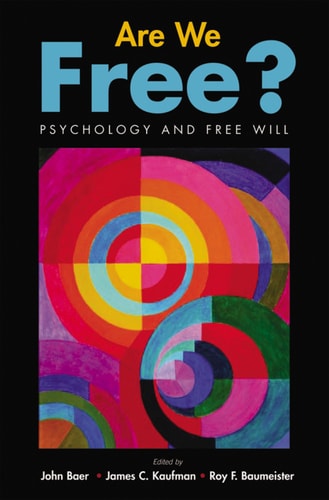
Are We Free? Psychology and Free Will
0
0
As an Amazon Associate and affiliate partner, Menrva Books earns from qualifying purchases. Learn more
Author Description
Do people have free will, or this universal belief an illusion? If free will is more than an illusion, what kind of free will do people have? How can free will influence behavior? Can free will be studied, verified, and understood scientifically? How and why might a sense of free will have evolved? These are a few of the questions this book attempts to answer.People generally act as though they believe in their own free will: they don't feel like automatons, and they don't treat one another as they might treat robots. While acknowledging many constraints and influences on behavior, people nonetheless act as if they (and their neighbors) are largely in control of many if not most of the decisions they make. Belief in free will also underpins the sense that people are responsible for their actions. Psychological explanations of behavior rarely mention free will as a factor, however. Can psychological science find room for free will? How do leading psychologists conceptualize free will, and what role do they believe free will plays in shaping behavior?In recent years a number of psychologists have tried to solve one or more of the puzzles surrounding free will. This book looks both at recent experimental and theoretical work directly related to free will and at ways leading psychologists from all branches of psychology deal with the philosophical problems long associated with the question of free will, such as the relationship between determinism and free will and the importance of consciousness in free will. It also includes commentaries by leading philosophers on what psychologists can contribute to long-running philosophical struggles with this most distinctly human belief. These essays should be of interest not only to social scientists, but to intelligent and thoughtful readers everywhere.
Menrva's Summary
THE THESIS
This book investigates whether the concept of free will can be empirically studied, verified, and integrated into modern psychological science. The authors, including prominent psychologists Roy F. Baumeister, James C. Kaufman, and John Baer, assemble a collection of essays that bridge the gap between philosophical inquiry and experimental research. By examining the evolutionary, cognitive, and social dimensions of agency, the text argues that free will is not merely a philosophical abstraction but a functional psychological construct that influences human behavior and social responsibility.
THE SCOPE MAP
What You Will Find
- Theoretical frameworks linking determinism and conscious decision-making
- Experimental research on the psychological mechanisms of self-control and choice
- Commentary from philosophers regarding the intersection of psychology and ethics
- Evolutionary perspectives on the development of agency
Scope Limits
- Does not provide a definitive metaphysical proof of free will
- Does not focus on theological or purely religious interpretations of the soul
THE AUTHORITY PERSPECTIVE
Experts recognize this volume as a significant interdisciplinary effort to bring rigorous scientific inquiry to a traditionally philosophical domain. Readers frequently note that the text provides a balanced overview of current psychological debates, making it accessible to both social scientists and interested laypeople.
Page Count:
367
Publication Date:
2008-01-01
Publisher:
Oxford University Press
ISBN-10:
0190293470
ISBN-13:
9780190293475
Philosophy
Non-Fiction
Psychology
Behavioral Science
Community Tags
Similar Books