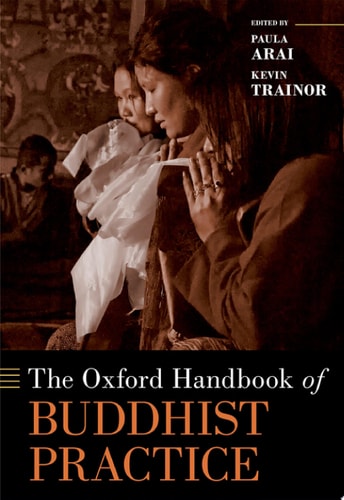
The Oxford Handbook of Buddhist Practice
0
0
As an Amazon Associate and affiliate partner, Menrva Books earns from qualifying purchases. Learn more
Author Description
Popular representations of Buddhism often depict it as spiritual, disembodied, and largely devoid of ritual. Yet embodiment, materiality, emotion, and gender shape the way most Buddhists engage with their traditions. The essays within The Oxford Handbook of Buddhist Practice push beyond traditional representations of Buddhism as divided into static schools and traditions, highlighting instead the contested and negotiated character of individual and group identities.This volume will serve as a corrective to the common misconception that Buddhist practice is limited to seated meditation and that ritualized activities are not an integral dimension of authoritative Buddhist practice. Essays in this handbook explore the transformational aims of practices that require practitioners to move, gesture, and emote in prescribed ways, including the ways that scholars' own embodied practices are integral to their research methodology. Authors foreground the role of the body, examining how the senses, gender, specific emotions, and material engagements impact religious experience. They highlight, as well, the multiplicity of methods and theoretical perspectives that scholars of Buddhism use in their research and writing, including field-based, textual, and historical approaches. Given the fluidity and diversity of Buddhist practices, the question that animates this volume is: What makes a given practice Buddhist?
Menrva's Summary
THE THESIS
This volume investigates the core question of what defines a practice as Buddhist by challenging the common misconception that the tradition is primarily disembodied or limited to seated meditation. Editors Kevin Trainor and Paula Kane Robinson Arai assemble a collection of scholarly essays that examine how materiality, emotion, gender, and physical movement shape religious engagement. The text argues that ritualized activities are an integral, authoritative dimension of Buddhist life rather than peripheral additions.
THE SCOPE MAP
What You Will Find
- Analysis of embodied religious practices including movement, gesture, and sensory engagement.
- Methodological discussions on how scholars incorporate their own embodied experiences into research.
- Exploration of the intersection between gender, material culture, and religious identity.
- Diverse research approaches including field-based, textual, and historical analysis.
Scope Limits
- The volume does not provide a comprehensive history of every Buddhist school or sect.
- It does not serve as a basic introductory guide to Buddhist theology or philosophy.
THE AUTHORITY PERSPECTIVE
Scholars and students of religious studies frequently cite this handbook as a significant corrective to text-heavy or meditation-centric interpretations of Buddhism. Experts highlight the text's academic density and its utility as a foundational resource for understanding the material and ritual dimensions of the tradition.
Page Count:
688
Publication Date:
2022-06-03
Publisher:
Oxford University Press
ISBN-10:
0190632925
ISBN-13:
9780190632922
Religion
Ritual Studies
Academic
Buddhism
Anthropology Of Religion
Community Tags
Other Editions(2)
Similar Books