Africa's Pulse Spring 2015
0
0
As an Amazon Associate and affiliate partner, Menrva Books earns from qualifying purchases. Learn more
Author Description
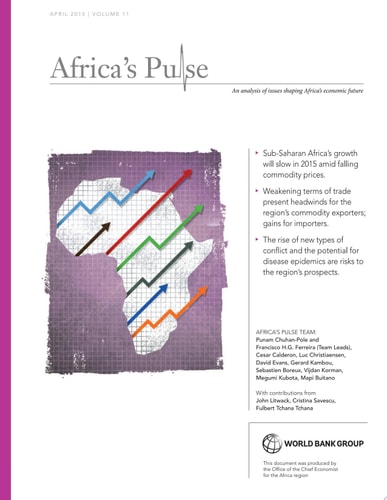
Africa’s Pulse is a biannual publication containing an analysis of the near-term macro-economic outlook for the region. It also includes a section focusing on a topic that represents a particular development challenges for the continent. It is produced by the Office of the Chief Economist for the Africa Region.This issue is an analysis of issues shaping Africa's economic future. Growth remains stable in Sub-Saharan Africa. Some countries are seeing a slowdown, but the region's economic prospects remain broadly favorable. External risks of higher global financial market volatility and lower growth in emerging market economies weigh on the downside. In several Sub-Saharan African countries, large budgetary imbalances are a source of vulnerability to exogenous shocks and underscore the need for rebuilding fiscal buffers in these countries. The Ebola outbreak is exacting a heavy human and economic toll on affected countries and, if not rapidly contained, the risk of wider contagion grows. Without a scale-up of effective interventions, growth would slow markedly not only in the core countries (Guinea, Liberia, and Sierra Leone), but also in the sub region as transportation, cross-border trade, and supply chains are severely disrupted. In Sub-Saharan Africa, growth in agriculture and services is more effective at reducing poverty than growth in industry. Structural transformation has a role to play in accelerating poverty reduction in Sub-Saharan Africa. Increasing agricultural productivity will be critical to fostering structural transformation. Boosting rural income diversification can facilitate this transformation, as well. Investments in rural public goods and services (for example, education, health, rural roads, electricity and ICT), including in small towns, will be conducive to lifting productivity in the rural economy. Although Sub-Saharan Africa's pattern of growth has largely bypassed manufacturing, growing the region's manufacturing base, especially by improv
Menrva's Summary
THE THESIS
This publication analyzes the near-term macroeconomic outlook for Sub-Saharan Africa and addresses key development challenges facing the continent. Produced by the Office of the Chief Economist for the Africa Region, this Spring 2015 issue examines issues shaping Africa's economic future, noting stable growth across the region despite some country-specific slowdowns. It highlights external risks such as global financial market volatility and lower growth in emerging market economies, as well as internal vulnerabilities like large budgetary imbalances in several countries. The Ebola outbreak's significant human and economic toll and its potential for wider contagion are also detailed, alongside the disruptive impact on trade and supply chains.
THE SCOPE MAP
- Analysis of the near-term macro-economic outlook for Sub-Saharan Africa.
- Focus on a specific development challenge: the Ebola outbreak and its economic impact.
- Discussion of regional economic prospects, including stable growth and external risks.
- Examination of internal vulnerabilities such as budgetary imbalances.
- Analysis of the role of agriculture and services in poverty reduction.
- Exploration of structural transformation and increasing agricultural productivity.
- Consideration of investments in rural public goods and services to boost productivity.
- Discussion on growing the region's manufacturing base.
THE AUTHORITY PERSPECTIVE
This publication is a biannual report from the Office of the Chief Economist for the Africa Region, offering expert analysis on the continent's economic trajectory. The Spring 2015 issue provides a detailed look at macroeconomic trends, identifying both favorable prospects and significant risks. It emphasizes the importance of fiscal prudence and structural reforms for sustained development. The report also addresses critical contemporary issues like the Ebola outbreak and its far-reaching economic consequences.
Page Count:
49
Publication Date:
2015-04-13
Publisher:
World Bank Publications
ISBN-10:
1464806152
ISBN-13:
9781464806155
Non-Fiction
Economics
Africa
Community Tags
Similar Books