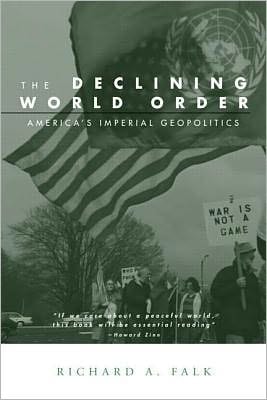
The Declining World Order
0
0
As an Amazon Associate and affiliate partner, Menrva Books earns from qualifying purchases. Learn more
Author Description
This work delineates the impact of terrorism--and the American response--on the basic structure of international relations, the dimming prospects for global reform and the tendency to override the role of sovereign territorial states. Falk examines the changing role of the state, the relevance of institutions, the role of individuals and the importance of the worldwide religious resurgence, with its positive and negative implications. He also considers the post-modern geopolitics of the Bush presidency, with its emphasis on the militarization of space, the control of oil in the Middle East, and its reliance on military capabilities so superior to that of other states as to make any challenge impractical.
Menrva's Summary
THE THESIS
This work investigates how the post-9/11 American response to terrorism has fundamentally altered the structure of international relations and diminished the prospects for global reform. Richard Falk, a prominent scholar of international law and global politics, utilizes a critical framework to analyze the erosion of sovereign state roles and the rise of a post-modern geopolitical paradigm. He argues that the shift toward unilateral military dominance and the militarization of space represents a significant departure from established international norms and institutional cooperation.
THE SCOPE MAP
What You Will Find
- Analysis of the impact of global terrorism on international legal structures
- Examination of the Bush presidency's geopolitical strategies regarding Middle Eastern oil and military superiority
- Evaluation of the worldwide religious resurgence and its influence on state sovereignty
- Discussion on the declining relevance of traditional international institutions in a unipolar world
THE AUTHORITY PERSPECTIVE
Experts and political observers frequently cite this text as a critical examination of early 21st-century American foreign policy. Readers often note the author's rigorous, academic approach to analyzing the intersection of military power and global governance.
Page Count:
280
Publication Date:
2004-01-01
Publisher:
New York : Routledge, 2004.
ISBN-10:
0203485564
ISBN-13:
9780203485569
History
Geopolitics
Foreign Policy
International relations
Community Tags
Similar Books