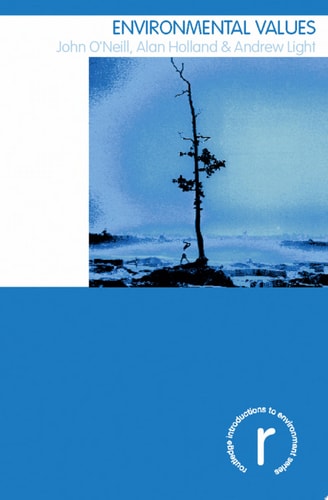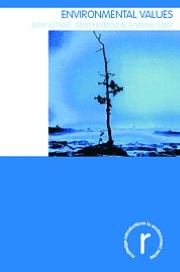
Environmental Values
0
0
As an Amazon Associate and affiliate partner, Menrva Books earns from qualifying purchases. Learn more
Author Description
We live in a world confronted by mounting environmental problems; increasing global deforestation and desertification, loss of species diversity, pollution and global warming. In everyday life people mourn the loss of valued landscapes and urban spaces. Underlying these problems are conflicting priorities and values. Yet dominant approaches to policy-making seem ill-equipped to capture the various ways in which the environment matters to us.Environmental Values introduces readers to these issues by presenting, and then challenging, two dominant approaches to environmental decision-making, one from environmental economics, the other from environmental philosophy. The authors present a sustained case for questioning the underlying ethical theories of both of these traditions. They defend a pluralistic alternative rooted in the rich everyday relations of humans to the environments they inhabit, providing a path for integrating human needs with environmental protection through an understanding of the narrative and history of particular places. The book examines the implications of this approach for policy issues such as biodiversity conservation and sustainability.Written in a clear and accessible style for an interdisciplinary audience, this volume will be ideal for student use in environmental courses in geography, economics, philosophy, politics and sociology.
Menrva's Summary
THE THESIS
This book investigates the inadequacy of traditional economic and philosophical frameworks in addressing modern environmental crises by questioning the ethical foundations of current policy-making. The authors, Alan Holland, Andrew Light, and John O'Neill, draw upon their expertise in environmental philosophy and policy to critique the narrow scope of dominant decision-making models. They argue that these models fail to account for the complex, multifaceted ways humans value their environments. In response, they propose a pluralistic alternative that emphasizes the importance of narrative, history, and local human-environment relations to better integrate human needs with conservation efforts.
THE SCOPE MAP
What You Will Find
- A critical analysis of environmental economics and environmental philosophy as decision-making frameworks.
- A proposed pluralistic approach that prioritizes the history and narrative of specific places.
- Case studies and theoretical applications regarding biodiversity conservation and sustainability.
- An interdisciplinary methodology suitable for students of geography, politics, and sociology.
THE AUTHORITY PERSPECTIVE
Experts and educators frequently cite this volume as a foundational text for interdisciplinary environmental courses due to its accessible prose and rigorous ethical inquiry. Readers note that the authors successfully bridge the gap between abstract philosophical theory and practical policy application.
Page Count:
246
Publication Date:
2008-01-01
Publisher:
Taylor & Francis, Inc.
ISBN-10:
0203495454
ISBN-13:
9780203495452
Philosophy
Economics
Sustainability
Ethics
Geography