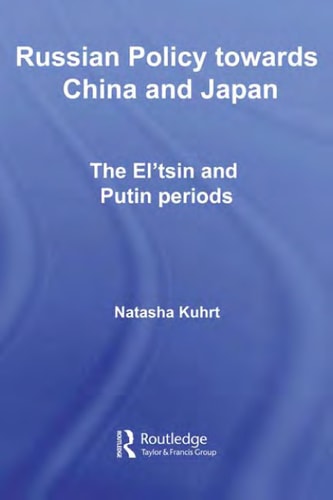
Russian Policy Towards China and Japan: The El'tsin and Putin Periods
0
0
As an Amazon Associate and affiliate partner, Menrva Books earns from qualifying purchases. Learn more
Author Description
Drawing On The Most Up-to-date Sources, This Book Provides An Examination Of Russia's Relations With China And Japan, The Two Asia-pacific Superpowers-in-waiting. For Russia There Has Always Been More Than One 'asia': After The Collapse Of The Soviet Union, There Were Those In The Russian Elite Who Saw Asia As Implying The Economic Dynamism Of The Asia-pacific, With Japan As The Main Player. However, There Were Others Who Saw The Chance For Russia To Reassert Its Claim To Be A Great Power, Based On Russia's Geopolitical And Geoeconomic Position As A Eurasian Power. For These, China Was The Power To Engage With: Together China And Russia Could Control Both Heartland And Rim, Both Eurasia And Asia-pacific, Whereas Accepting Japan's Conception Of Asia Implied Regional Fragmentation And Shared Sovereignty. This Book Argues That This Strand Of Thinking, Mainly Confined To Nationalists In The El'tsin Years, Has Now, Under Putin, Become The Dominant Discourse Among Russian Policymakers. Despite Opportunities For Convergence Presented By Energy Resources, Even For Trilateral Cooperation, Traditional Anxiety Regarding Loss Of Control Over Key Resource Areas In The Russian Far East Is Now Used To Inform Regional Policy, Leading To A New Resource Nationalism. In Light Of Russia's New Assertiveness In Global Affairs And Its Increasing Use Of The So-called 'energy Weapon' In Foreign Policy, This Book Will Appeal Not Only To Specialists On Russian Politics And Foreign Policy, But Also To International Relations Scholars.--book Jacket.
Menrva's Summary
THE THESIS
This book investigates how Russia's foreign policy toward China and Japan shifted from the post-Soviet transition under Boris Yeltsin to the assertive, resource-driven nationalism of the Vladimir Putin era. Natasha Kuhrt, a specialist in Russian foreign policy, utilizes a framework of geopolitical analysis to examine how Russian elites moved from viewing Japan as a model for economic dynamism to prioritizing a strategic partnership with China. The text argues that this transition reflects a broader effort to reassert Russia's status as a global power by leveraging its Eurasian position and energy resources.
THE SCOPE MAP
What You Will Find
- Comparative analysis of Russian diplomatic strategies toward China and Japan during the 1990s and 2000s.
- Examination of the 'energy weapon' as a tool for modern Russian foreign policy.
- Analysis of the tension between regional economic integration and the desire for centralized control over the Russian Far East.
- Historical review of border negotiations and trilateral cooperation efforts in the Asia-Pacific region.
THE AUTHORITY PERSPECTIVE
Experts identify this work as a significant contribution to the study of post-Soviet geopolitical strategy and resource nationalism. The text is noted for its academic rigor and is frequently cited by scholars of international relations for its detailed examination of the shift in Russian elite discourse.
Page Count:
228
Publication Date:
2007-01-01
Publisher:
Routledge
ISBN-10:
0203716884
ISBN-13:
9780203716885
History
China
Russia
Japan
Foreign Policy
International relations