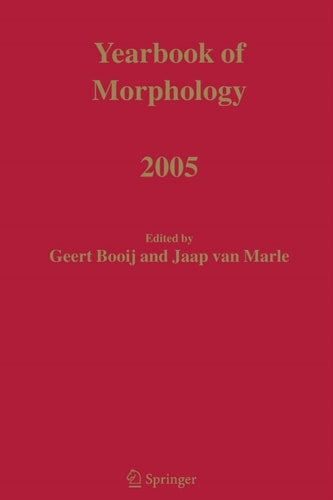
Yearbook of Morphology 2005
0
0
As an Amazon Associate and affiliate partner, Menrva Books earns from qualifying purchases. Learn more
Author Description
A revival of interest in morphology has occurred during recent years. The periodical Yearbook of Morphology, published since 1988, has proven to be an eminent support for this upswing of morphological research, and has shown that morphology is central to present-day linguistic theorizing. In the Yearbook of Morphology 2005 a number of important theoretical issues are discussed: the role of inflectional paradigms in morphological analysis, the differences between words and affixes, and the adequacy of competing models of word structure. In addition, the role of phonological factors in shaping complex words is discussed. Evidence for particular positions defended in this volume is taken from a wide variety of languages. This volume is of interest to those working in theoretical, descriptive and historical linguistics, morphologists, phonologists, computational linguists, and psycholinguists. Beginning with Volume 16 (2006) the Yearbook of Morphology continues as a journal with the title: Morphology. This is the only journal entirely devoted to the study of linguistic morphology. The journal is available online as well as in print. Visit the journal at: www.springer.com/11525 or click on the link in the top right hand corner.
Menrva's Summary
THE THESIS
The Yearbook of Morphology 2005 investigates key theoretical issues in the study of linguistic morphology, a field experiencing a resurgence of interest. This volume, edited by Geert Booij and Jaap van Marle, supports this upswing by demonstrating morphology's centrality to contemporary linguistic theorizing. It delves into critical discussions on the role of inflectional paradigms, the distinctions between words and affixes, and the effectiveness of various models of word structure. Furthermore, the influence of phonological factors on the formation of complex words is examined, drawing evidence from a diverse range of languages.
THE SCOPE MAP
- Discussion on the role of inflectional paradigms in morphological analysis.
- Examination of the differences between words and affixes.
- Evaluation of competing models of word structure.
- Analysis of the role of phonological factors in shaping complex words.
- Evidence drawn from a wide variety of languages.
- Contributions relevant to theoretical, descriptive, and historical linguistics.
- Content of interest to morphologists, phonologists, computational linguists, and psycholinguists.
THE AUTHORITY PERSPECTIVE
The Yearbook of Morphology 2005 is presented as a significant support for the recent revival of interest in morphology, positioning the field as central to modern linguistic theory. It addresses important theoretical debates, including the function of inflectional paradigms, the word-affix distinction, and models of word structure, alongside the impact of phonology on word formation. The volume is intended for a specialized audience, including theoretical, descriptive, and historical linguists, as well as morphologists, phonologists, computational linguists, and psycholinguists. This particular volume marks a continuation of the periodical, which would later evolve into the journal 'Morphology' starting with Volume 16 (2006).
Page Count:
316
Publication Date:
2006-10-11
Publisher:
Springer Nature
ISBN-10:
1402040660
ISBN-13:
9781402040665
Science
Non-Fiction
Linguistics
Psycholinguistics
Morphology
Phonology
Computational linguistics
Community Tags
Similar Books