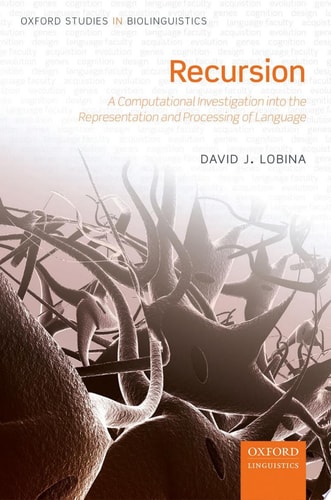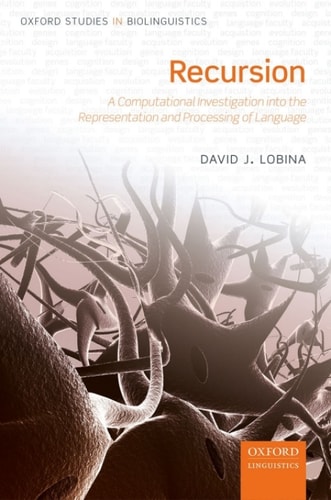
Recursion: A Computational Investigation into the Representation and Processing of Language
0
0
As an Amazon Associate and affiliate partner, Menrva Books earns from qualifying purchases. Learn more
Author Description
This book provides a comprehensive account of the role of recursion in language in two distinct but interconnected ways. First, David J. Lobina examines how recursion applies at different levels within a full description of natural language. Specifically, he identifies and evaluates recursion as: a) a central property of the computational system underlying the faculty of language; b) a possible feature of the derivations yielded by this computational system; c) a global characteristic of the structures generated by the language faculty; and d) a probable factor in the parsing operations employed during the processing of recursive structures. Second, the volume orders these different levels into a tripartite explanatory framework. According to this framework, the investigation of any particular cognitive domain must begin by first outlining what sort of mechanical procedure underlies the relevant capacity (including what sort of structures it generates). Only then, the author argues, can we properly investigate its implementation, both at the level of abstract computations typical of competence-level analyses, and at the level of the real-time processing of behaviour.
Menrva's Summary
THE THESIS
This book investigates the fundamental role of recursion within the computational architecture of human language and its implications for cognitive processing. David J. Lobina, a researcher in the field of biolinguistics, constructs a tripartite explanatory framework to reconcile abstract linguistic competence with real-time behavioral performance. By analyzing recursion across structural, derivational, and processing levels, the author argues for a systematic approach to understanding the mechanical procedures that define the language faculty.
THE SCOPE MAP
What You Will Find
- A four-part classification of recursion as a property, derivation, structure, and parsing operation.
- A tripartite framework for cognitive domain investigation.
- Theoretical synthesis of competence-level analysis and real-time processing models.
Scope Limits
- The text focuses primarily on biolinguistic and computational perspectives rather than sociolinguistic or historical language evolution.
- It does not provide an exhaustive survey of all competing syntactic theories outside of the generative tradition.
THE AUTHORITY PERSPECTIVE
Experts recognize this work as a specialized contribution to the Oxford Studies in Biolinguistics series, suitable for advanced students and researchers in cognitive science. Readers frequently note the academic density of the prose and the rigorous, technical nature of the author's proposed framework.
Page Count:
288
Publication Date:
2017-01-01
Publisher:
OUP Oxford
ISBN-10:
0191087971
ISBN-13:
9780191087974
Linguistics
English
Computational linguistics
Philosophy of
Biolinguistics
English & College Success
Community Tags
Other Editions(3)
Similar Books