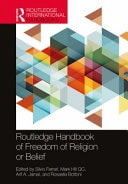
Routledge Handbook of Freedom of Religion or Belief
0
0
As an Amazon Associate and affiliate partner, Menrva Books earns from qualifying purchases. Learn more
Author Description
Freedom Of Religion Is An Issue Of Universal Interest And Scope. However, In The Last Two Centuries At Least, The Philosophical, Religious And Legal Terms Of The Question Have Been Largely Defined In The West. In An Increasingly Global World, Widening Our Knowledge Of This Right's Roots In Different Cultural And Legal Systems Becomes A Priority. This Handbook Seeks To Attain This Goal Through A Better Understanding Of The Historical Roots And Expressions Of The Right To Freedom Of Religion On The One Hand And, On The Other, Of Its Theological Background In Different Religious Traditions. History And Theology Provide The Setting For The Analysis Of The Politics Of Freedom Of Religion, That Is, How This Right Is Used In The Context Of The Dialogue/confrontation Between Countries Placed In Different Cultural Regions Of The World, And Of The Legal Strategies And Tools That Have Been Developed And Are Employed To Protect And Foster The Right To Freedom Of Religion. Behind These Legal And Political Strategies, There Is An Ongoing Debate About The Nature Of This Right, Whose Main Features Are Explored In The Final Section. Global, Historical And Interdisciplinary In Approach, This Book Studies The New Relevance Of Freedom Of Religion Worldwide And Develops Suitable Categories To Analyze And Understand The Role That Freedom Of Religion Can Play In Managing Religious And Cultural Diversity In Our Societies. Authored By Experts, Through The Contributions Collected In These Chapters, Scholars And Students Will Be Able To Broaden And Deepen Their Knowledge Of The Right To Freedom Of Religion And To Develop The Ability To Go Beyond The Borders Of The Different Cultural Environments In Which This Right Took Shape And Developed.
Menrva's Summary
THE THESIS
This handbook investigates the global evolution, theological foundations, and legal implementation of the right to freedom of religion or belief in an increasingly diverse world. The authors, a team of distinguished legal scholars and experts, synthesize historical, theological, and political perspectives to challenge the Western-centric definitions that have historically dominated the discourse. By examining how different cultural and legal systems interpret this fundamental right, the text provides a framework for managing religious diversity in contemporary societies.
THE SCOPE MAP
What You Will Find
- Historical analysis of the roots and expressions of religious freedom across various global cultures.
- Theological background studies covering multiple religious traditions and their impact on legal rights.
- Examination of the political strategies and international dialogues used to protect religious freedom.
- A comprehensive exploration of the nature and theoretical features of the right to freedom of religion.
THE AUTHORITY PERSPECTIVE
Experts identify this handbook as a foundational, interdisciplinary resource for scholars and students navigating the complexities of international human rights law. Readers frequently note the academic density of the prose, which serves as a rigorous reference for those studying the intersection of law, politics, and theology.
Page Count:
292
Publication Date:
2020-01-01
Publisher:
Taylor & Francis Group
ISBN-10:
0203732626
ISBN-13:
9780203732625
History
Religion
Law
Theology
Human rights
Community Tags
Similar Books