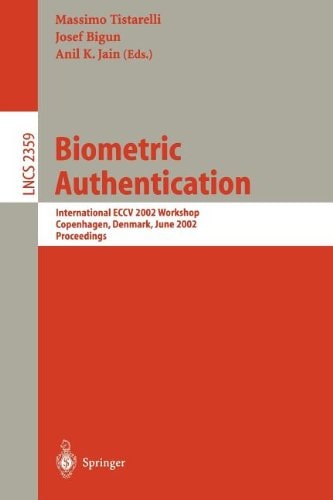
Biometric Authentication: International ECCV 2002 Workshop, Copenhagen, Denmark, June 1, 2002, Proceedings
0
0
As an Amazon Associate and affiliate partner, Menrva Books earns from qualifying purchases. Learn more
Author Description
Biometric authentication refers to identifying an individual based on his or her distinguishing physiological and/or behavioral characteristics. It associates an individual with a previously determined identity based on that individual s appearance or behavior. Because many physiological or behavioral characteristics (biometric indicators) are distinctive to each person, biometric identifiers are inherently more reliable and more capable than knowledge-based (e.g., password) and token-based (e.g., a key) techniques in differentiating between an authorized person and a fraudulent impostor. For this reason, more and more organizations are looking to automated identity authentication systems to improve customer satisfaction, security, and operating efficiency as well as to save critical resources. Biometric authentication is a challenging pattern recognition problem; it involves more than just template matching. The intrinsic nature of biometric data must be carefully studied, analyzed, and its properties taken into account in developing suitable representation and matching algorithms. The intrinsic variability of data with time and environmental conditions, the social acceptability and invasiveness of acquisition devices, and the facility with which the data can be counterfeited must be considered in the choice of a biometric indicator for a given application. In order to deploy a biometric authentication system, one must consider its reliability, accuracy, applicability, and efficiency. Eventually, it may be necessary to combine several biometric indicators (multimodal-biometrics) to cope with the drawbacks of the individual biometric indicators.
Menrva's Summary
THE THESIS
The challenge of accurately identifying individuals based on unique physiological and behavioral characteristics forms the core of biometric authentication. This field of study, which associates individuals with predetermined identities through their distinct traits, offers a more reliable alternative to passwords or tokens. The proceedings explore the intricate pattern recognition problems inherent in biometric data, emphasizing the need to study and account for the intrinsic variability, social acceptability, and potential for counterfeiting of biometric indicators. Ultimately, the development of robust biometric systems requires careful consideration of reliability, accuracy, applicability, efficiency, and the potential integration of multimodal biometrics to overcome individual indicator limitations.
THE SCOPE MAP
- Key research papers from the ECCV 2002 workshop on Biometric Authentication.
- Discussions on physiological and behavioral characteristics used in identification.
- Analysis of pattern recognition challenges in biometric systems.
- Considerations for developing reliable and accurate biometric authentication systems.
- Exploration of multimodal biometrics for enhanced security.
- Insights into the intrinsic nature and variability of biometric data.
THE AUTHORITY PERSPECTIVE
This collection of proceedings from the 2002 ECCV workshop on Biometric Authentication presents foundational research in a rapidly evolving field. The papers likely offer detailed technical discussions on the challenges and methodologies of identifying individuals through their unique traits. The focus on pattern recognition and the intrinsic properties of biometric data suggests a readership of researchers and practitioners in computer science, security, and artificial intelligence. The inclusion of discussions on multimodal biometrics indicates an early exploration of advanced techniques for improving system robustness and accuracy.
Page Count:
202
Publication Date:
2002-06-01
Publisher:
Springer Berlin Heidelberg
ISBN-10:
3540829857
ISBN-13:
9783540829850
Science & Technology
Non-Fiction
Biometrics
Computer Science
Security
Community Tags
Other Editions(2)
Similar Books












Reader Comments
Share Your Thoughts
No comments yet. Be the first to share your thoughts!