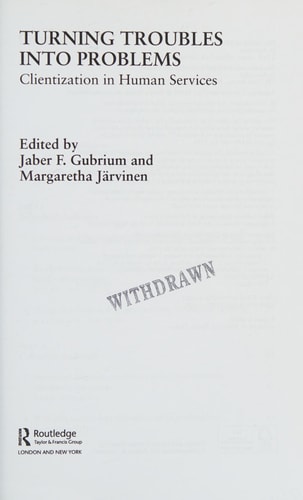
Turning Troubles into Problems: Clientization in Human Services
0
0
As an Amazon Associate and affiliate partner, Menrva Books earns from qualifying purchases. Learn more
Author Description
Human service professionals deal with a wide range of problems, from child abuse, parenting issues, and elderly care, to addictions, mental illness, sexual assault, unemployment, and criminality. These must be constructed as problems for professionals to appropriately respond to them. Human service provision starts from there. But in the everyday experience of service providers and users alike, there is a parallel world of ordinary troubles that remains professionally undefined but real, even when troubles are turned into problems. This book brings into view the relationship between these worlds as it bears on the process of clientization--the transformation of people and troubles into clients and problems. Rather than taking the process for granted as many critics do, the book examines the instability of the process on several fronts and highlights its surprising local complexity. Foregrounding everyday life, the leading idea is that the transformation of troubles into problems is not straightforward and that problems are continually subject to alternative understandings. This poses new what, how, and where questions. What are ordinary troubles and how do they relate to the construction, maintenance, or undoing of serviceable problems? Where is social policy and how does that figure in the front-line work of service provision? The questions point to the challenges of clientization at the discretionary border of troubles and problems in everyday service relationships. With chapters written by an international group of human service researchers, this book is an important contribution to the literature dealing with the construction of personal problems and will be useful to students and academics in sociology, human services, social work and policy, criminal justice, and health care.
Menrva's Summary
THE THESIS
This book investigates the complex, often unstable process of 'clientization,' where the everyday personal troubles of individuals are transformed into formal, actionable problems within human service systems. The authors, Jaber F. Gubrium and Margaretha Järvinen, assemble an international collection of researchers to examine how professionals navigate the discretionary boundary between subjective human experience and institutional categorization. By focusing on the front-line interactions between service providers and users, the text argues that this transformation is not a static or straightforward procedure but a continuous, negotiated activity subject to alternative interpretations.
THE SCOPE MAP
What You Will Find
- Analysis of the 'clientization' process in diverse sectors including mental health, elderly care, and criminal justice.
- Methodological frameworks for observing the construction of social problems in everyday service settings.
- Case studies illustrating the tension between personal 'troubles' and institutional 'problems.'
- Theoretical discussions on the role of social policy in shaping front-line professional discretion.
THE AUTHORITY PERSPECTIVE
Experts in sociology and social work identify this collection as a significant contribution to the study of institutional interaction and the social construction of reality. Readers frequently note the academic density of the prose, which serves as a foundational text for students and researchers analyzing the mechanics of human service provision.
Page Count:
235
Publication Date:
2014-01-01
Publisher:
Routledge
ISBN-10:
0203798015
ISBN-13:
9780203798010
Human services
Social service
Civil Service
Social Work
Sociology
Social Science
Public Policy
Social workers
Community Tags
Other Editions(2)

Similar Books














Reader Comments
Share Your Thoughts
No comments yet. Be the first to share your thoughts!