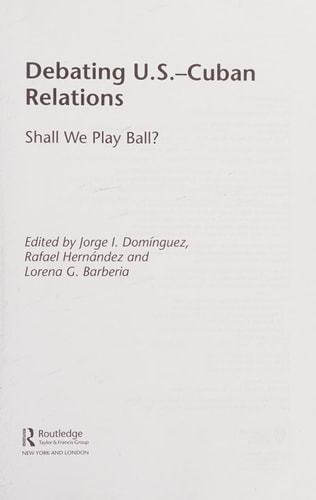
Debating U.S.-Cuban Relations: Shall We Play Ball?
0
0
As an Amazon Associate and affiliate partner, Menrva Books earns from qualifying purchases. Learn more
Author Description
Two Decades Ago Affairs Between The United States And Cuba Had Seen Little Improvement From The Cold War Era. Today, U.s.-cuban Relations Are In Many Respects Still In Poor Shape, Yet Some Cooperative Elements Have Begun To Take Hold And Offer Promise For Future Developments. Illustrated By The Ongoing Migration Agreement, Professional Military-to-military Relations At The Perimeter Of The U.s. Base Near Guantánamo, And Professional Coast Guard-guardafrontera Cooperation Across The Straits Of Florida, The Two Governments Are Actively Exploring Whether And How To Change The Pattern Of Interactions. The Differences That Divide The Two Nations Are Real, Not The Result Of Misperception, And This Volume Does Not Aspire To Solve All Points Of Disagreement. Drawing On Perspectives From Within Cuba As Well As Those In The United States, Canada, And Europe, These Authors Set Out To Analyze Contemporary Policies, Reflect On Current Circumstances, And Consider Possible Alternatives For Improved U.s.-cuban Relations. The Resulting Collection Is Permeated With Both Disagreements And Agreements From Leading Thinkers On The Spectrum Of Issues The Two Countries Face - Matters Of Security, The Role Of Europe And Latin America, Economic Issues, Migration, And Cultural And Scientific Exchanges In Relations Between Cuba And The United States. Each Topic Is Represented By Perspectives From Both Cuban And Non-cuban Scholars, Leading To A Resource Rich In Insight And A Model Of Transnational Dialogue. -- From Publisher Description.
Menrva's Summary
THE THESIS
This volume investigates the complex, often adversarial diplomatic history between the United States and Cuba to determine if cooperative frameworks can replace long-standing patterns of conflict. Jorge I. Domínguez and Rafael M. Hernández, both established scholars in Latin American studies, curate a collection of essays that synthesize perspectives from Cuban, American, Canadian, and European experts. The text utilizes a comparative analytical framework to examine specific policy areas where the two nations have attempted to engage, despite deep-seated ideological and political divisions.
THE SCOPE MAP
What You Will Find
- Analysis of security cooperation, including military-to-military relations at Guantánamo and anti-hijacking accords.
- Examination of economic, migration, and cultural exchange policies between the two nations.
- Comparative essays featuring viewpoints from both Cuban and international scholars to provide a balanced transnational perspective.
- Historical context regarding the evolution of U.S.-Cuban relations from the Cold War era to contemporary diplomatic efforts.
THE AUTHORITY PERSPECTIVE
Experts highlight this volume as a foundational text for understanding the nuances of transnational dialogue between the United States and Cuba. Readers frequently note the academic density of the prose and the value of the multi-perspective approach in navigating such a polarized subject.
Page Count:
268
Publication Date:
2011-01-01
Publisher:
Routledge
ISBN-10:
0203805704
ISBN-13:
9780203805701
History
Foreign Policy
United States
International relations
Cuba
Community Tags
Similar Books