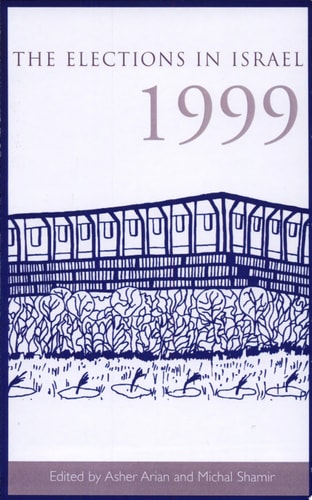
The Elections in Israel 1999
0
0
As an Amazon Associate and affiliate partner, Menrva Books earns from qualifying purchases. Learn more
Author Description
This volume highlights Israel’s 1999 elections, in which the prime-ministerial race between incumbent Benjamin Netanyahu and Ehud Barak ended with Barak winning by the biggest landslide ever in Israel. Although some observers interpreted these results as a fundamental shift in public opinion, there is little evidence to support this. The book shows how old patterns funneled into a new system of voting produced the 1999 results, where a weak candidate (Barak) bested a wounded prime minister (Netanyahu) abandoned by most of his political allies. Leading social scientists from Israeli and American universities, using a variety of approaches and coming from diverse intellectual traditions, address topics including the emergence of political blocs, strategic voting, and split ticket voting. In addition to major party performance, special interest parties—who did better than ever in 1999—are also discussed, such as the haredi, ultra-orthodox, non-Zionist Shas, the anti-haredi secular Shinui, two parties appealing to former Soviet émigrés and Arab parties.
Menrva's Summary
THE THESIS
The 1999 Israeli elections presented a paradox: a landslide victory that defied fundamental shifts in public opinion. The book examines how established voting patterns, interacting with a new electoral system, produced the unexpected outcome where Ehud Barak defeated incumbent Benjamin Netanyahu. Leading social scientists analyze the dynamics of bloc emergence, strategic voting, and split-ticket voting, alongside the notable success of special interest parties such as Shas, Shinui, parties for Soviet émigrés, and Arab parties.
THE SCOPE MAP
- Analysis of the 1999 Israeli prime-ministerial race between Benjamin Netanyahu and Ehud Barak.
- Examination of the factors contributing to Barak's landslide victory.
- Discussion on whether the results indicated a fundamental shift in public opinion.
- Exploration of how old patterns interacted with a new voting system.
- Analysis of the emergence of political blocs.
- Investigation into strategic voting and split ticket voting.
- Coverage of special interest parties, including Shas, Shinui, parties for Soviet émigrés, and Arab parties.
THE AUTHORITY PERSPECTIVE
This volume is a scholarly examination of the 1999 Israeli elections, drawing on the expertise of leading social scientists from both Israeli and American universities. The contributors employ diverse approaches to dissect the electoral mechanics and voter behavior, offering a nuanced perspective that challenges simplistic interpretations of the results. The book's strength lies in its detailed analysis of how established political patterns interacted with a new voting system to produce the outcome, providing valuable insights into Israeli political science.
Page Count:
297
Publication Date:
2002-03-28
Publisher:
SUNY Press
ISBN-10:
0791453154
ISBN-13:
9780791453155
History
Politics
Non-Fiction
Elections
Social Science
Community Tags
Similar Books