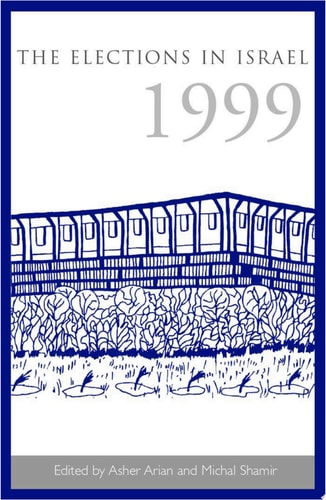
The Elections in Israel 1999
0
0
As an Amazon Associate and affiliate partner, Menrva Books earns from qualifying purchases. Learn more
Author Description
Considers the impact of the 1999 Israeli elections. This volume highlights Israel's 1999 elections, in which the prime-ministerial race between incumbent Benjamin Netanyahu and Ehud Barak ended with Barak winning by the biggest landslide ever in Israel. Although some observers interpreted these results as a fundamental shift in public opinion, there is little evidence to support this. The book shows how old patterns funneled into a new system of voting produced the 1999 results, where a weak candidate (Barak) bested a wounded prime minister (Netanyahu) abandoned by most of his political allies. Leading social scientists from Israeli and American universities, using a variety of approaches and coming from diverse intellectual traditions, address topics including the emergence of political blocs, strategic voting, and split ticket voting. In addition to major party performance, special interest parties-who did better than ever in 1999-are also discussed, such as the haredi, ultra-orthodox, non-Zionist Shas, the anti-haredi secular Shinui, two parties appealing to former Soviet émigrés and Arab parties.
Menrva's Summary
THE THESIS
This volume analyzes the complex factors that shaped the 1999 Israeli elections, moving beyond superficial interpretations of a fundamental public opinion shift. The book argues that the election results were a product of old patterns of political behavior interacting with a new voting system. It demonstrates how a relatively weak candidate, Ehud Barak, was able to defeat a weakened incumbent, Benjamin Netanyahu, who had lost the support of his political allies.
THE SCOPE MAP
- Analysis of the emergence and dynamics of political blocs in Israel.
- Examination of strategic voting and split-ticket voting patterns.
- Discussion of the performance of major parties and special interest parties.
- Detailed look at specific parties including the haredi Shas, secular Shinui, parties for former Soviet émigrés, and Arab parties.
THE AUTHORITY PERSPECTIVE
This collection of essays by leading social scientists from Israeli and American universities offers a rigorous, multi-faceted examination of the 1999 Israeli elections. The contributors, drawing from diverse intellectual traditions, provide in-depth analyses of voting behavior, political blocs, and the performance of various parties, including significant special interest groups. The work is structured to challenge simplistic interpretations of the election outcomes, instead highlighting the interplay of established political patterns and evolving electoral systems.
Page Count:
303
Publication Date:
2012-02-01
Publisher:
State University of New York Press (SUNY Press)
ISBN-10:
0791488810
ISBN-13:
9780791488812
History
Politics
Non-Fiction
Social Science
Elections
Community Tags
Similar Books