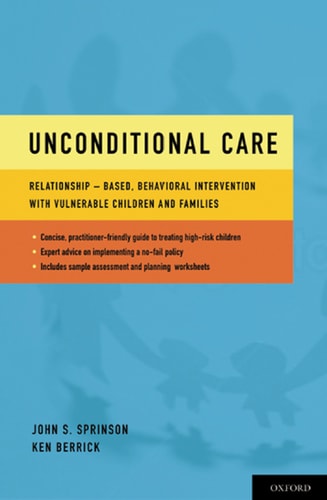
Unconditional Care: Relationship-Based, Behavioral Intervention with Vulnerable Children and Families
0
0
As an Amazon Associate and affiliate partner, Menrva Books earns from qualifying purchases. Learn more
Author Description
This clinician-friendly guide presents a model for engaging the most challenging children and families who are served by the child welfare, mental health, juvenile justice, and special educations systems. These children are among the most troubled clients that treatment providers will ever encounter. They have been failed by every adult, every treatment modality, and every system of care that they have encountered. Unconditional Care, a breakthrough guide from the founder and clinical director of California's Seneca Center for Children and Families, offers both a theoretical model and practical guidelines for working with this most difficult group of children. The approach weaves together attachment theory and learning theory into a coherent relationship-based intervention strategy built around a no-fail policy: a child can never be discharged from a program for exhibiting the behaviors that resulted in the placement. Professionals working with these families instead focus on re-building relationships that teach children to secure safe and supportive relationships with caregivers using new behaviors and skills to replace the destructive ones that have, until now, organized their worldview. The concept of unconditional care allows, for the first time, a safe space for youth to reconstruct their perceptions of themselves and those who care for them. Rich case examples, quick-reference bullets and boxes, and sample assessment and planning worksheets make this a handy clinical reference and training tool for mental health and child welfare professionals.
Menrva's Summary
THE THESIS
How can service providers effectively engage and support the most challenging youth within the child welfare, mental health, and juvenile justice systems? John S. Sprinson and Ken Berrick, drawing on their leadership at the Seneca Center for Children and Families, propose a relationship-based intervention model. This framework integrates attachment theory and learning theory to create a stable environment where children cannot be discharged due to the very behaviors that necessitated their placement. The authors argue that by prioritizing consistent, unconditional support, professionals can help youth replace destructive patterns with secure, functional relational skills.
THE SCOPE MAP
What You Will Find
- A theoretical framework combining attachment and learning theories
- A no-fail policy model for program management
- Practical clinical guidelines for relationship-based intervention
- Assessment and planning worksheets for practitioners
- Case studies illustrating the application of the model
Scope Limits
- The text focuses primarily on institutional and clinical settings rather than general parenting advice
- It does not cover long-term longitudinal outcomes for every specific demographic within the child welfare system
THE AUTHORITY PERSPECTIVE
Professionals in the fields of social work and mental health frequently cite this work as a practical, clinician-friendly resource for managing high-acuity cases. Experts highlight the book's utility as both a training tool and a foundational reference for implementing systemic changes in care delivery.
Page Count:
303
Publication Date:
2010-01-01
Publisher:
Oxford University Press
ISBN-10:
0190453540
ISBN-13:
9780190453541
Psychology
Introduction to Social WorkWelfare
Education
Child Welfare
Social Work
Mental Health
Professional Development
Community Tags
Similar Books