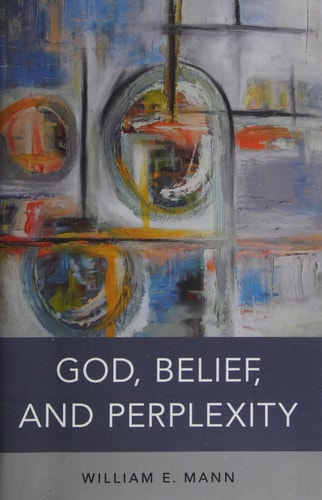
God, Belief, and Perplexity
0
0
As an Amazon Associate and affiliate partner, Menrva Books earns from qualifying purchases. Learn more
Author Description
This volume presents fourteen of William E. Mann's essays on three prominent figures in late Patristic and early medieval philosophy: Augustine, Anselm, and Peter Abelard. The essays explore some of the quandaries, arguments, and theories presented in their writings. The essays in this volume complement those to be found in Mann's God, Modality, and Morality (OUP, 2015). While the essays in God, Modality, and Morality are primarily essays in philosophical theology, those found in the present volume are more varied. Some still deal with issues in philosophical theology. Other essays are aporetic in nature, discussing cases of philosophical perplexity, sometimes but not always leaving the cases unresolved.All the essays display, directly or indirectly, the philosophical influence that Augustine has had. His Confessions is a rich source for philosophical puzzlement. Individual essays examine his reflections on the alleged innocence of infants, which raises questions about cognitive, emotional, and linguistic development; his juvenile theft of pears and its relation to moral motivation; and his struggle with and resolution of the problem of evil. One essay presents the rudiments of an Augustinian moral theory, rooted in his understanding of the Sermon on the Mount. Another essay illustrates the theory by discussing his writings on lying. Mann argues that Abelard amplified Augustine's moral theory by emphasizing the crucial role that intention plays in wrongdoing.Augustine bequeathed to Anselm the notion of "faith seeking understanding." Mann argues that this methodological slogan shapes Anselm's "ontological argument" for God's existence and his efforts to explicate the doctrine of the Trinity.
Menrva's Summary
THE THESIS
This volume investigates the intersection of faith, moral motivation, and philosophical perplexity through the writings of Augustine, Anselm, and Peter Abelard. William E. Mann, a scholar of medieval philosophy, utilizes a collection of fourteen essays to analyze how these thinkers navigated complex theological and ethical quandaries. By examining primary texts, the author constructs a framework that links Augustinian influence to the subsequent developments in Anselmian logic and Abelardian moral theory.
THE SCOPE MAP
What You Will Find
- Analysis of Augustinian moral theory regarding lying and the Sermon on the Mount
- Examination of Anselm's ontological argument and the doctrine of the Trinity
- Discussion of Abelard's emphasis on intention in moral wrongdoing
- Exploration of aporetic cases involving cognitive and linguistic development
Scope Limits
- The text does not provide a comprehensive history of medieval philosophy
- It does not offer a systematic theology but rather focuses on specific philosophical problems
THE AUTHORITY PERSPECTIVE
Scholars and students of medieval philosophy frequently note the technical rigor and analytical depth of Mann's prose. Experts highlight this collection as a valuable resource for those interested in the evolution of philosophical theology from the Patristic era through the early medieval period.
Page Count:
272
Publication Date:
2016-06-01
Publisher:
Oxford University Press
ISBN-10:
0190459204
ISBN-13:
9780190459208
Philosophy
Patristic Philosophy
Metaphysics
Ethics
Theology
Community Tags
Other Editions(3)


Similar Books





Reader Comments
Share Your Thoughts
No comments yet. Be the first to share your thoughts!