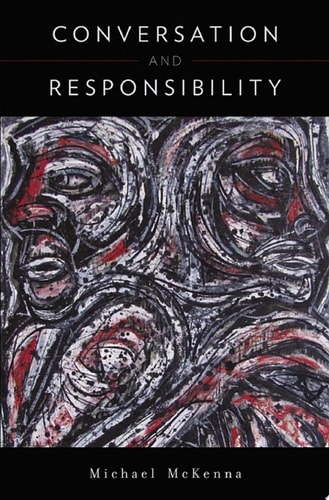
Conversation and Responsibility
0
0
As an Amazon Associate and affiliate partner, Menrva Books earns from qualifying purchases. Learn more
Author Description
In this book Michael McKenna advances a new theory of moral responsibility, one that builds upon the work of P. F. Strawson. As McKenna demonstrates, moral responsibility can be explained on analogy with a conversation. The relation between a morally responsible agent and those who hold her morally responsible is similar to the relation between a speaker and her audience. A responsible agent's actions are bearers of meaning--agent meaning--just as a speaker's utterances are bearers of speaker meaning. Agent meaning is a function of the moral quality of the will with which the agent acts. Those who hold an agent morally responsible for what she does do so by responding to her as if in a conversation. By responding with certain morally reactive attitudes, such as resentment or indignation, they thereby communicate their regard for the meaning taken to be revealed in that agent's actions. It is then open for the agent held responsible to respond to those holding her responsible by offering an apology, a justification, an excuse, or some other response, thereby extending the evolving conversational exchange.The conversational theory of moral responsibility that McKenna develops here accepts two features of Strawson's theory: that moral responsibility is essentially interpersonal--so that being responsible must be understood by reference to the nature of holding responsible--and that the moral emotions are central to holding responsible. While upholding these two aspects of Strawson's theory, McKenna's theory rejects a further Strawsonian thesis, which is that holding morally responsible is more fundamental or basic than being morally responsible. On the conversational theory, the conditions for holding responsible are dependent on the nature of the agent who is responsible. So holding responsible cannot be more basic than being responsible. Nevertheless, the nature of the agent who is morally responsible is to be understood in terms of sensitivity to those who would mak
Menrva's Summary
THE THESIS
Michael McKenna investigates the core question of how moral responsibility functions as an interpersonal, communicative process rather than a purely internal state. Drawing on the foundational work of P. F. Strawson, McKenna argues that moral responsibility is best understood through an analogy to conversation, where an agent's actions carry meaning that elicits reactive attitudes from others, creating an ongoing exchange of moral accountability.
THE SCOPE MAP
What You Will Find
- A conversational framework for interpreting agent meaning and moral quality of will.
- An analysis of reactive attitudes such as resentment and indignation as communicative acts.
- A critique of the Strawsonian thesis regarding the priority of holding responsible versus being responsible.
Scope Limits
- The text does not provide a comprehensive legal or political theory of responsibility.
- It does not address every possible counter-argument from hard determinist perspectives.
THE AUTHORITY PERSPECTIVE
Experts in moral philosophy recognize this work as a significant contribution to the ongoing debate surrounding Strawsonian ethics. Readers frequently note the academic density of the prose, which is intended for scholars and advanced students of philosophy.
Page Count:
272
Publication Date:
2012-01-01
Publisher:
Oxford University Press
ISBN-10:
0190453850
ISBN-13:
9780190453855
Philosophy
Moral Philosophy
Metaphysics
Ethics
Social Philosophy
Responsibility
Community Tags
Other Editions(3)
Similar Books









Reader Comments
Share Your Thoughts
No comments yet. Be the first to share your thoughts!