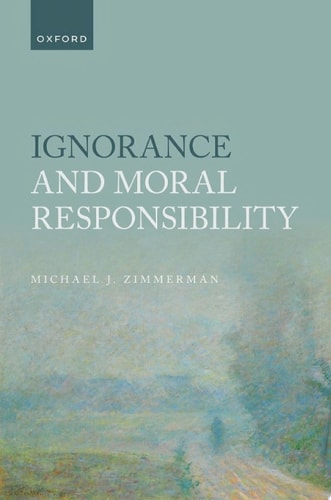
Ignorance and Moral Responsibility
0
0
As an Amazon Associate and affiliate partner, Menrva Books earns from qualifying purchases. Learn more
Author Description
Michael J. Zimmerman investigates the relation between ignorance and moral responsibility. He begins with the presentation of a case in which a tragedy occurs, one to which many people have unwittingly contributed, and addresses the question of whether their ignorance absolves them of blame for what happened. Inspection of the case issues in the Argument from Ignorance, whose conclusion is that, to be blameworthy for one's behaviour and its consequences, one must at some time in the history of that behaviour have known that one was engaged in wrongdoing-a thesis that threatens to undermine many everyday ascriptions of responsibility. This argument is examined and refined in ensuing chapters by way of, first, a detailed inquiry into the nature of moral responsibility, ignorance, and control, all of which play a crucial role in the argument, and then an application of the fruits of this investigation to the question of whether and how someone might be to blame for behaviour that stems from either culpable ignorance, negligence, recklessness, or the kind of fundamental moral ignorance that often characterizes evildoers. The Argument from Ignorance implies that in a great many such cases the agent has an excuse for the wrongdoing in question. This is a disturbing verdict, and in the final chapter challenges to the argument are entertained. Despite the merits of some of these challenges, it is held that the argument, revised one last time, survives them.
Menrva's Summary
THE THESIS
Does ignorance of wrongdoing absolve an agent of moral responsibility for their actions and the resulting consequences? Michael J. Zimmerman, a prominent philosopher in the field of ethics, constructs a rigorous analytical framework to evaluate the 'Argument from Ignorance.' He examines the historical and logical conditions required for moral culpability, specifically focusing on whether an agent must possess prior knowledge of wrongdoing to be held accountable for their behavior.
THE SCOPE MAP
What You Will Find
- An analysis of the relationship between moral responsibility, ignorance, and personal control.
- A systematic evaluation of culpable ignorance, negligence, and recklessness as factors in moral blame.
- A philosophical inquiry into the nature of fundamental moral ignorance in evildoers.
Scope Limits
- The text does not provide a sociological or legal analysis of responsibility, focusing strictly on the philosophical and ethical dimensions.
- It does not offer a comprehensive survey of all historical ethical theories, but rather focuses on the specific implications of the Argument from Ignorance.
THE AUTHORITY PERSPECTIVE
Scholars and students of ethics frequently note the high level of analytical density and logical precision present in Zimmerman's prose. Experts highlight this work as a significant contribution to contemporary debates regarding moral agency and the limits of accountability.
Page Count:
392
Publication Date:
2022-01-01
Publisher:
OUP Oxford
ISBN-10:
0192675672
ISBN-13:
9780192675675
Philosophy
Responsibility
Epistemology
Ethics
Moral Philosophy
Community Tags
Similar Books