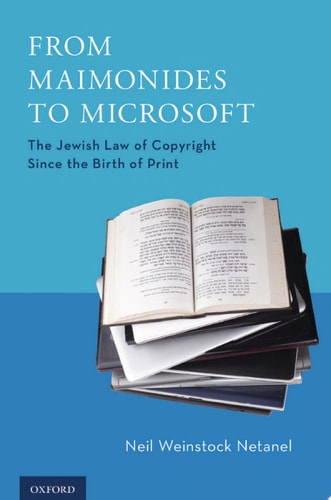
From Maimonides to Microsoft: The Jewish Law of Copyright Since the Birth of Print
0
0
As an Amazon Associate and affiliate partner, Menrva Books earns from qualifying purchases. Learn more
Author Description
Jewish copyright law is a rich body of jurisprudence that developed in parallel with modern copyright laws and the book privileges that preceded them. Jewish copyright law owes its origins to a reprinting ban that the Rome rabbinic court issued for three books of Hebrew grammar in 1518. It continues to be applied today, notably in a rabbinic ruling outlawing pirated software, issued at Microsoft's request.In From Maimonides to Microsoft, Professor Netanel traces the historical development of Jewish copyright law by comparing rabbinic reprinting bans with secular and papal book privileges and by relaying the stories of dramatic disputes among publishers of books of Jewish learning and liturgy.. He describes each dispute in its historical context and examines the rabbinic rulings that sought to resolve it. Remarkably, the rabbinic reprinting bans and copyright rulings address some of the same issues that animate copyright jurisprudence today: Is copyright a property right or just a right to receive fair compensation? How long should copyrights last? What purposes does copyright serve? While Jewish copyright law has borrowed from its secular law counterpart at key junctures, it fashions strikingly different answers to those key questions.The story of Jewish copyright law also intertwines with the history of the Jewish book trade and with steadfast efforts of rabbinic leaders to maintain their authority to regulate that trade in the face of the dramatic erosion of Jewish communal autonomy in the eighteenth and nineteenth centuries. This book will thus be of considerable interest to students of Jewish law and history as well as copyright scholars and practitioners.
Menrva's Summary
THE THESIS
This book investigates the historical evolution and contemporary application of Jewish copyright law, examining how rabbinic rulings have navigated the tension between communal authority and the regulation of the book trade. Neil Weinstock Netanel, a professor of law, utilizes a comparative analysis of rabbinic reprinting bans alongside secular and papal book privileges to trace this legal development. The work argues that Jewish jurisprudence offers distinct perspectives on fundamental copyright questions, such as the nature of property rights and the duration of protection, while simultaneously reflecting the broader history of Jewish communal autonomy.
THE SCOPE MAP
What You Will Find
- Historical analysis of rabbinic reprinting bans starting from 1518.
- Comparative study of Jewish legal responses versus secular and papal book privileges.
- Examination of modern applications, including rabbinic rulings on software piracy.
- Documentation of disputes among publishers of Jewish learning and liturgy.
Scope Limits
- The text does not provide a comprehensive manual for modern copyright litigation.
- It does not cover the entirety of Jewish commercial law beyond the specific context of the book trade.
THE AUTHORITY PERSPECTIVE
Legal scholars and historians identify this work as a significant contribution to the intersection of religious law and intellectual property. Readers frequently note the academic rigor of the prose and the clarity with which the author connects ancient rabbinic precedents to contemporary digital-age legal dilemmas.
Page Count:
333
Publication Date:
2016-01-01
Publisher:
Oxford University Press
ISBN-10:
0190456647
ISBN-13:
9780190456641
Religion
History
Intellectual Property
Professional Career & Trade
Legal History
Law
Jewish law
Jewish Studies
Jewish History
Community Tags
Similar Books