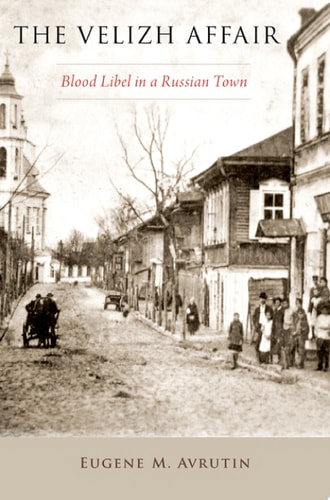
The Velizh Affair: Blood Libel in a Russian Town
0
0
As an Amazon Associate and affiliate partner, Menrva Books earns from qualifying purchases. Learn more
Author Description
On April 22, 1823, a three-year-old boy named Fedor finished his lunch and went to play outside. Fedor never returned home from his walk. Several days later, a neighbor found his mutilated body drained of blood and repeatedly pierced. In small market towns, where houses were clustered together, residents knew each other on intimate terms, and people gossiped in taverns, courtyards, and streets, even the most trivial bits of news spread like wildfire. It did not take long before rumors began to emerge that Jews murdered the little boy. The Velizh Affair reconstructs the lives of Jews and their Christian neighbors caught up in the aftermath of this chilling criminal act. The investigation into Fedor's death resulted in the charging of forty-three Jews with ritual murder, theft and desecration of Church property, and the forcible conversion of three town residents. Drawing on an astonishing number of newly discovered trial records, historian Eugene M. Avrutin explores the multiple factors that not only caused fear and conflict in everyday life, but also the social and cultural worlds of a multiethnic population that had coexisted for hundreds of years. This beautifully crafted book provides an intimate glimpse into small-town life in eastern Europe. The case unfolded in a town like any other town in the Russian Empire where lives were closely interwoven, where rivalries and confrontations were part of day-to-day existence, and where the blood libel was part of a well-established belief system.
Menrva's Summary
THE THESIS
This book investigates the origins and societal impact of the 1823 Velizh blood libel case, questioning how deep-seated cultural prejudices and local rivalries fueled a massive criminal investigation against a Jewish community. Historian Eugene M. Avrutin utilizes newly discovered trial records to reconstruct the social and cultural landscape of a multiethnic Russian town. He argues that the accusation was not an isolated event but a manifestation of long-standing tensions and belief systems within the Russian Empire. By examining the lives of both the accused and the accusers, the author provides a framework for understanding how communal fear transformed a local tragedy into a protracted legal and social crisis.
THE SCOPE MAP
What You Will Find
- Detailed analysis of the 1823 Velizh murder investigation and subsequent trial.
- Examination of the social and cultural dynamics of multiethnic life in the Russian Empire.
- Use of primary source trial records and archival documentation.
- Exploration of the historical prevalence of blood libel as a belief system.
Scope Limits
- The study is geographically focused on the town of Velizh and its immediate surroundings.
- The narrative does not attempt to provide a comprehensive history of all anti-Semitic tropes in Europe.
THE AUTHORITY PERSPECTIVE
Historians and scholars of Eastern European studies recognize this work as a rigorous examination of the intersection between local social friction and imperial legal processes. Readers frequently note the meticulous use of archival evidence to illuminate the complexities of nineteenth-century Russian provincial life.
Page Count:
245
Publication Date:
2017-01-01
Publisher:
Oxford University Press
ISBN-10:
0190640545
ISBN-13:
9780190640545
Religion
History
True Crime
Social History
Russian History
Judaism
Trials Murder
Antisemitism
Jewish Studies
Legal History
Professional Career & Trade
European History
Community Tags
Similar Books