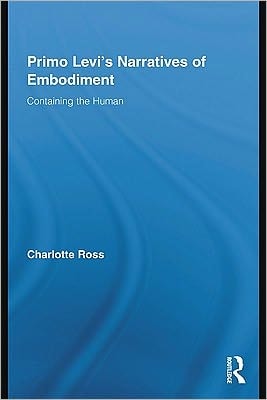
Primo Levi's Narratives of Embodiment: Containing the Human
0
0
As an Amazon Associate and affiliate partner, Menrva Books earns from qualifying purchases. Learn more
Author Description
This innovative reading of Primo Levi’s work offers the first sustained analysis in English of his representations of bodies and embodiment. Discussion spans the range of Levi’s works — from testimony to journalism, from essays to science fiction stories — identifying and tracing multiple narratives of embodiment and disembodiment across his oeuvre. These narratives range from the abject, disembodied condition of prisoners in Auschwitz, to posthuman or cyborg individuals, whose bodies merge with technological devices. Levi’s representations of bodies are explored in relation to theories of embodiment and posthumanism, bringing his work into new dialogue with critical discourses on these issues. Taking inspiration from Levi’s definition of the human being as a constructor of containers, as well as from the recurring references to both material and metaphorical containing structures in his work, the book suggests that for Levi, embodiment involves constant negotiations of containment. He depicts the complex relationships between physical and social bodies, the material and the immaterial self, the conscious and unconscious subject, the organic and the technologically-enhanced body, engaging with evolving understandings of the boundaries of the body, the self, and the human.
Menrva's Summary
THE THESIS
This book investigates how Primo Levi utilizes the concept of the body as a container to define the boundaries of human identity and existence. Charlotte Ross, an expert in Italian studies, examines Levi’s diverse literary output—spanning testimony, essays, and science fiction—to argue that his work consistently negotiates the tension between physical containment and the fluid nature of the self. By applying theories of posthumanism and embodiment, the author demonstrates how Levi’s writing serves as a critical site for exploring the intersection of the organic, the technological, and the social body.
THE SCOPE MAP
What You Will Find
- Analysis of the full range of Levi’s oeuvre, including his Holocaust testimony and speculative fiction.
- Application of posthumanist and embodiment theories to 20th-century Italian literature.
- Examination of the 'container' metaphor as a structural device in Levi’s prose.
- Exploration of the boundaries between the material self and technological integration.
THE AUTHORITY PERSPECTIVE
Scholars recognize this work as a significant contribution to Levi studies, particularly for its focus on the intersection of his scientific background and literary output. The text is noted for its academic rigor and its ability to bridge the gap between historical trauma and contemporary philosophical discourse on the posthuman condition.
Page Count:
240
Publication Date:
2010-01-01
Publisher:
Taylor & Francis Group
ISBN-10:
0203837193
ISBN-13:
9780203837191
Philosophy
Biography
Literary Criticism
In literature